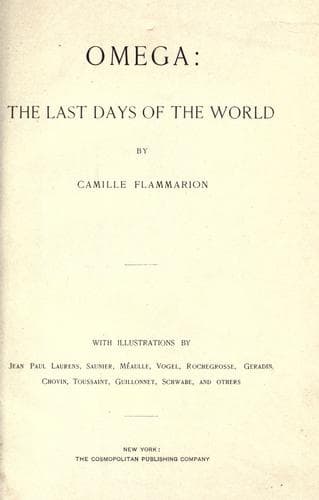
Omega: The Last days of the WorldFlammarion, Camille
Philosophy
Omega: The Last days of the World
Flammarion, Camille
End of the world -- Fiction; Science fiction
“One thing is certain, that the sun will finally lose its heat; it is
condensing and contracting, and its fluidity is decreasing. The time
will come when the circulation, which now supplies the photosphere, and
makes the central mass a reservoir of radiant energy, will be obstructed
and will slacken. The radiation of heat and light will then diminish,
and vegetable and animal life will be more and more restricted to the
earth’s equatorial regions. When this circulation shall have ceased, the
brilliant photosphere will be replaced by a dark opaque crust which will
prevent all luminous radiation. The sun will become a dark red ball,
then a black one, and night will be perpetual. The moon, which shines
only by reflection, will no longer illumine the lonely nights. Our
planet will receive no light but that of the stars. The solar heat
having vanished, the atmosphere will remain undisturbed, and an absolute
calm, unbroken by any breath of air, will reign.
“If the oceans still exist they will be frozen ones, no evaporation will
form clouds, no rain will fall, no stream will flow. Perhaps, as has
been observed in the case of stars on the eve of extinction, some last
flare of the expiring torch, some accidental development of heat, due to
the falling in of the sun’s crust, will give us back for a while the
old-time sun, but this will only be the precursor of the end; and the
earth, a dark ball, a frozen tomb, will continue to revolve about the
black sun, travelling through an endless night and hurrying away with
all the solar system into the abyss of space. _It is to the extinction
of the sun that the earth will owe its death, twenty, perhaps forty
million years hence._”
The speaker ceased, and was about to leave the platform, when the
director of the academy of fine arts begged to be heard:
“Gentlemen,” he said, from his chair, “if I have understood rightly, the
end of the world will in any case result from cold, and only several
million years hence. If, then, a painter should endeavor to represent
the last day, he ought to shroud the earth in ice, and cover it with
skeletons.”
[Illustration:
A WORLD OF ICE.
]
“Not exactly,” replied the Columbian chancellor. “It is not cold which
produces glaciers,—it is _heat_.
“If the sun did not evaporate the sea water there would be no clouds,
and but for the sun there would be no wind. For the formation of
glaciers a sun is necessary, to vaporize the water and to transport it
in clouds and then to condense it. Every kilogram of vapor formed
represents a quantity of solar heat sufficient to raise five kilograms
of cast-iron to its fusing point (110°). By lessening the intensity of
the sun’s action we exhaust the glacier supply.
Public-domain text, read in full here on John Shaqi.
Reviews
Reviews
No reviews yet
Be the first to share your thoughts on this work.
Elsewhere in the archive
Join the Discussion
Join the discussion
Sign in to leave a comment or review.
Sign InorCreate an account