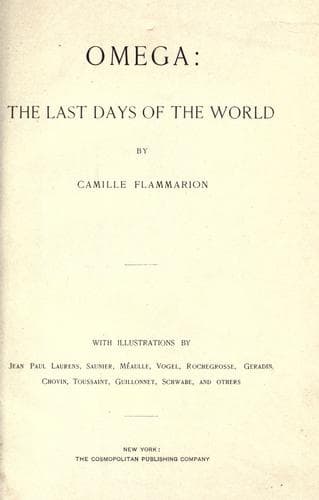
Omega: The Last days of the WorldFlammarion, Camille
Philosophy
Omega: The Last days of the World
Flammarion, Camille
End of the world -- Fiction; Science fiction
“To resume,” continued the director of the Paris observatory, “after all
we have just now heard, we see that our planet will be at a loss to
choose among so many modes of death. I have as little fear now as before
of any danger from the present comet. But it must be confessed that,
solely from the point of view of the astronomer, this poor, wandering
earth is exposed to more than one peril. The child born into this world,
and destined to reach the age of maturity, may be compared to a person
stationed at the entrance to a narrow street, one of those picturesque
streets of the sixteenth century, lined with houses at whose every
window is a marksman armed with a good weapon of the latest model. This
person must traverse the entire length of the street, without being
stricken down by the weapons levelled upon him at close range. Every
disease which lies in wait and threatens us, is on hand: dentition,
convulsion, croup, meningitis, measles, smallpox, typhoid fever,
pneumonia, enteritis, brain fever, heart disease, consumption, diabetes,
apoplexy, cholera, influenza, etc., etc., for we omit many, and our
hearers will have no difficulty in supplementing this off-hand
enumeration. Will our unhappy traveller reach the end of the street safe
and sound? If he does, it will only be to die, just the same.
[Illustration:
“LIKE A CHARGE OF SHOT UPON A MEADOW LARK.”
]
“Thus our planet pursues its way along its heavenly path, with a speed
of more than 100,000 kilometers per hour, and, at the same time, the sun
hurries it on, with all the planets, toward the constellation of
Hercules. Recapitulating what has just been said, and allowing for what
may have been omitted: it may meet a comet ten or twenty times larger
than itself, composed of deleterious gases which would render the
atmosphere irrespirable; it may encounter a swarm of uranolites, which
would have upon it the effect of a charge of shot upon a meadow lark; it
may meet in its path an invisible sun, much larger than itself, whose
shock would reduce it to vapor; it may encounter a sun which would
consume it in the twinkling of an eye, as a furnace would consume an
apple thrown into it; it may be caught in a system of electric forces,
which would act like a brake upon its eleven motions, and which would
either melt it, or set it afire, like a platinum wire in a strong
current; it may lose the oxygen which supports life; it may be blown up
like the crust over a crater; it may collapse in some great earthquake;
its dry land may disappear, in a second deluge, more universal than the
first; it may, on the contrary, lose all its water, an element essential
to its organic life; under the attraction of some passing body, it may
be detached from the sun and carried away into the cold of stellar
space; it may part, not only with the last vestige of its internal heat,
which long since has ceased to have any influence upon its surface, but
also with the protecting envelope which maintains the temperature
Public-domain text, read in full here on John Shaqi.
Reviews
Reviews
No reviews yet
Be the first to share your thoughts on this work.
Elsewhere in the archive
Join the Discussion
Join the discussion
Sign in to leave a comment or review.
Sign InorCreate an account