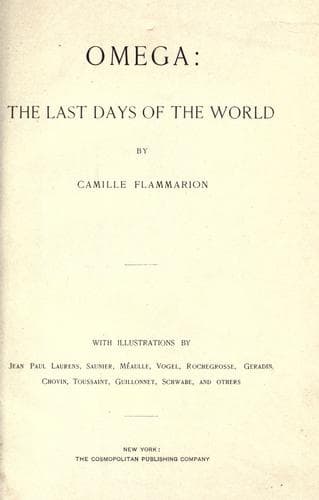
Omega: The Last days of the WorldFlammarion, Camille
Philosophy
Omega: The Last days of the World
Flammarion, Camille
End of the world -- Fiction; Science fiction
“So that it is not the snow, nor the glaciers which will cover the
earth, but the frozen remnant of the sea. For a long time previously
streams and rivers will have ceased to exist and every atmospheric
current will have disappeared, unless indeed, before giving up the
ghost, the sun shall have passed through one of those spasms to which we
referred a moment ago, shall have released the ice from sleep and have
produced new clouds and aerial currents, reawakened the springs, the
brooks and the rivers, and after this momentary but deceitful awakening,
shall have fallen back again into lethargy. That day will have no
morrow.”
Another voice, that of a celebrated electrician, was heard from the
center of the hemicycle.
“All these theories of death by cold,” he observed, “are plausible. But
the end of the world by fire? This has been referred to only in
connection with the comet. It may happen otherwise.
“Setting aside a possible sinking of the continents into the central
fire, brought about by an earthquake on a large scale, or some
widespread dislocation of the earth’s crust, it seems to me that,
without any collision, a superior will might arrest our planet midway in
its course and transform its motion into heat.”
“A will?” interrupted another voice. “But positive science does not
admit the possibility of miracles in nature.”
“Nor I, either,” replied the electrician. “When I say ‘will,’ I mean an
ideal, invisible force. Let me explain.
“The earth is flying through space with a velocity of 106,000 kilometers
per hour, or 29,460 meters per second. If some star, active or extinct,
should emerge from space, so as to form with the sun a sort of
electro-dynamic couple with our planet on its axis, acting upon it like
a brake—if, in a word, for any reason, the earth should be suddenly
arrested in its orbit, its mechanical energy would be changed into
molecular motion, and its temperature would be suddenly raised to such a
degree as to reduce it entirely to a gaseous state.”
“Gentlemen,” said the director of the Mont Blanc observatory, from his
chair, “the earth might perish by fire in still another manner. We have
lately seen in the sky a temporary star which, in a few weeks, passed
from the sixteenth to the fourth magnitude. This distant sun had
suddenly become 50,000 times hotter and more luminous. If such a fate
should overtake our sun, nothing living would be left upon our planet.
It is probable, from the study of the spectrum of the light emitted by
this burning star, that the cause of this sudden conflagration was the
entrance of this sun and its system into some kind of nebula. Our own
sun is travelling with a frightful velocity in the direction of the
constellation of Hercules, and may very well some day encounter an
obstacle of this nature.”
Public-domain text, read in full here on John Shaqi.
Reviews
Reviews
No reviews yet
Be the first to share your thoughts on this work.
Elsewhere in the archive
Join the Discussion
Join the discussion
Sign in to leave a comment or review.
Sign InorCreate an account