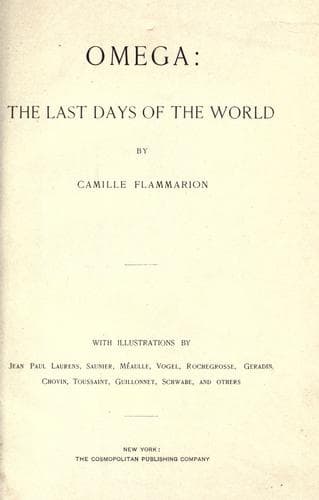
Omega: The Last days of the WorldFlammarion, Camille
Philosophy
Omega: The Last days of the World
Flammarion, Camille
End of the world -- Fiction; Science fiction
“What is the principle of identity in a living body? Assuredly it does
not consist in the complete and persistent identity of its _matter_. For
in this continual change and renewal, which is the very essence of
physiological life, the elements, which have belonged successively from
infancy to old age to the same human being, would form a colossal body.
In this torrent of life the elements pass and change ceaselessly; but
the organism remains the same, notwithstanding the modifications in its
size, its form and its constitution. Does the growing stem of the oak,
hidden between its two cotyledons, cease to be the same plant when it
has become a mighty oak? Is the embryo of the caterpillar, while yet in
the egg, no longer the same insect when it becomes a caterpillar, and
then a chrysalis, and then a butterfly? Is individuality lost as the
child passes through manhood to old age? Assuredly not. But in the case
of the oak, the butterfly, and the man, is there a single remaining
molecule of those which constituted the growing stem of the oak, the egg
of the caterpillar or the human embryo? What then is the principle which
persists through all these changes? This principle is a reality, not a
fiction. It is not the soul, for the plants have life, and yet no souls,
in the meaning of the word as we use it. Nevertheless, it must be an
imponderable agent. Does it survive the body? It is possible. St.
Gregory of Nyssus believed so. If it remains united to the soul, it may
be invoked to furnish it with a new body identical with that which death
has destroyed, even though this body should not possess _a single
molecule_ which it possessed at any period of its terrestrial life, and
this would be as truly our body as that which we had when five, fifteen,
or thirty, or sixty years of age.
“Such a conception agrees perfectly with the expressions of holy writ,
according to which it is certain that after a period of separation the
soul will again take on the body forever.
“In addition to St. Gregory of Nyssus, permit me, most reverend fathers,
to cite a philosopher Leibnitz, who held the opinion that the
physiological principle of life was imponderable but not incorporeal,
and that the soul remains united to this principle, although separated
from the ponderable and visible body. I do not pretend to either accept
or reject this hypothesis. I only note that it may serve to explain the
dogma of the resurrection, in which every Christian should firmly
believe.”
Public-domain text, read in full here on John Shaqi.
Reviews
Reviews
No reviews yet
Be the first to share your thoughts on this work.
Elsewhere in the archive
Join the Discussion
Join the discussion
Sign in to leave a comment or review.
Sign InorCreate an account