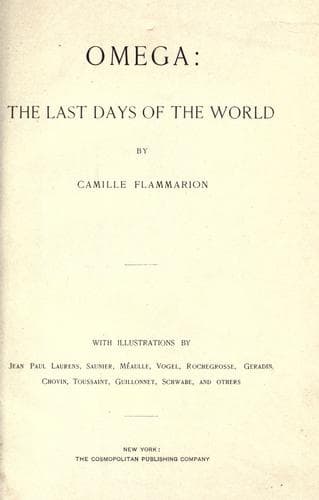
Omega: The Last days of the WorldFlammarion, Camille
Philosophy
Omega: The Last days of the World
Flammarion, Camille
End of the world -- Fiction; Science fiction
The somber year 1000 had followed the vanished centuries into the past,
but through what troubled times the Church had passed! The popes were
the puppets of the rival Saxon emperors and the princes of Latium. All
Christendom was in arms. The crisis had passed, but the problem of the
end of the world remained, and credence in this dread event, though
uncertain and vague,—was fostered by that profound belief in the devil
and in prodigies which was yet to endure for centuries in the popular
mind. The final scene of the last judgment was sculptured over the
portals of every cathedral, and on entering the sanctuary of the church
one passed under the balance of the archangel, on whose left writhed the
bodies of the devils and the damned, delivered over to the eternal
flames of hell.
[Illustration]
But the idea that the world was to end was not confined to the Church.
In the twelfth century astrologers terrified Europe by the announcement
of a conjunction of all the planets in the constellation of the scales.
This conjunction indeed, occurred, for on September 15th all the planets
were found between the 180th and 190th degrees of longitude. But the end
of the world did not come.
The celebrated alchemist, Arnauld de Villeneuve, foretold it again for
the year 1335. In 1406, under Charles VI., an eclipse of the sun,
occurring on June 16th, produced a general panic, which is chronicled by
Juvénal of the Ursuline Order: “It is a pitiable sight,” he says, “to
see people taking refuge in the churches as if the world were about to
perish.” In 1491 St. Vincent Ferrier wrote a treatise entitled, “De la
Fin du Monde et de la Science Spirituelle.” He allows Christendom as
many years of life as there are verses in the psalter, namely, 2537.
Then a German astrologer, one Stoffler, predicted that on February 20,
1524, a general deluge would result from a conjunction of the planets.
He was very generally believed, and the panic was extreme. Property
situated in valleys, along river banks, or near the sea, was sold to the
less credulous for a mere nothing. A certain doctor, Auriol, of
Toulouse, had an ark built for himself, his family and his friends, and
Bodin asserts that he was not the only one who took this precaution.
[Illustration]
Public-domain text, read in full here on John Shaqi.
Reviews
Reviews
No reviews yet
Be the first to share your thoughts on this work.
Elsewhere in the archive
Join the Discussion
Join the discussion
Sign in to leave a comment or review.
Sign InorCreate an account