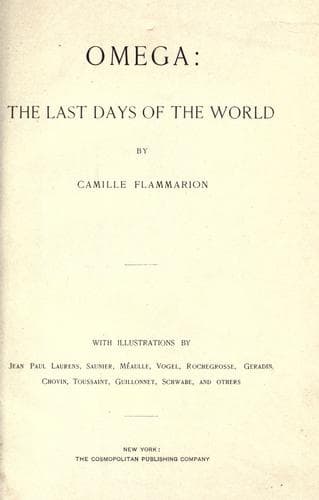
Omega: The Last days of the WorldFlammarion, Camille
Philosophy
Omega: The Last days of the World
Flammarion, Camille
End of the world -- Fiction; Science fiction
One of the greatest comets which ever struck the imagination of men was
assuredly the famous comet of 1680, to which Newton devoted so much
attention. “It issued,” said Lemonnier, “with a frightful velocity from
the depths of space and seemed falling directly into the sun and was
seen to vanish with an equal velocity. It was visible for four months.
It approached quite near to the earth, and Whiston ascribed the deluge
to its former appearance.” Bayle wrote a treatise to prove the absurdity
of beliefs founded on these portents. Madame de Sévigné writing to her
cousin, Count de Bussy-Rabutin, says: “We have a comet of enormous size;
its tail is the most beautiful object conceivable. Every person of note
is alarmed and believes that heaven, interested in their fate, sends
them a warning in this comet. They say that the courtiers of Cardinal
Mazarin, who is despaired of by his physicians believe this prodigy is
in honor of his passing away, and tell him of the terror with which it
has inspired them. He had the sense to laugh at them, and to reply
facetiously that the comet did him too much honor. In truth we ought all
to agree with him, for human pride assumes too much when it believes
that death is attended by such signs from heaven.”
We see that comets were gradually losing their prestige. Yet we read in
a treatise of the astronomer Bernouilli this singular remark: “If the
head of the comet be not a visible sign of the anger of God, _the tail
may well be_.”
Fear of the end of the world was reawakened by the appearance of comets
in 1773; a great panic spread throughout Europe, and Paris itself was
alarmed. Here is an extract from the memoirs of Bachaumont, accessible
to every reader:
“May 6th, 1773. In the last public meeting of the Academy of Sciences,
M. de Lalande was to read by far the most interesting paper of all;
this, however, he was not able to do, for lack of time. It concerned the
comets which, by approaching the earth, may cause revolutions, and dealt
especially with that one whose return is expected in eighteen years. But
although he affirmed that it was not one of those which would harm the
earth, and that, moreover, he had observed that one could not fix, with
any exactness, the order of such occurrences, there exists,
nevertheless, a very general anxiety.
“May 9th. The cabinet of M. de Lalande is filled with the curious who
come to question him concerning the above memoir, and, in order to
reassure those who have been alarmed by the exaggerated rumors
circulated about it, he will doubtless be forced to make it public. The
excitement has been so great that some ignorant fanatics have besought
the archbishop to institute prayers for forty hours, in order to avert
the deluge which menaces us; and this prelate would have authorized
these prayers, had not the Academy shown him the ridicule which such a
step would produce.
Public-domain text, read in full here on John Shaqi.
Reviews
Reviews
No reviews yet
Be the first to share your thoughts on this work.
Elsewhere in the archive
Join the Discussion
Join the discussion
Sign in to leave a comment or review.
Sign InorCreate an account