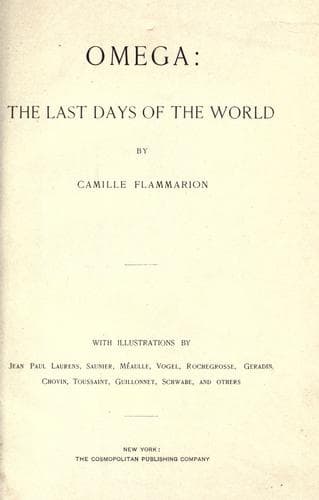
Omega: The Last days of the WorldFlammarion, Camille
Philosophy
Omega: The Last days of the World
Flammarion, Camille
End of the world -- Fiction; Science fiction
CHAPTER VII.
Inexorably, with a fatality no power could arrest, like a projectile
speeding from the mouth of a cannon toward the target, the comet
continued to advance, following its appointed path, and hurrying, with
an ever-increasing velocity, toward the point in space at which the
earth would be found on the night of July 14–15. The final calculations
were absolutely without error. These two heavenly bodies—the earth and
the comet—were to meet like two trains, rushing headlong upon each
other, with resistless momentum, as if impelled to mutual destruction by
an insatiable rage. But in the present instance the velocity of shock
would be 865 times that of two express trains having each a speed of one
hundred kilometers per hour.
During the night of July 13–14, the comet spread over nearly the entire
sky, and whirlwinds of fire could be seen by the naked eye, eddying
about an axis oblique to the zenith. The appearance was that of an army
of flaming meteors, in whose midst the flashing lightning produced the
effect of a furious combat. The burning star had a revolution of its
own, and seemed to be convulsed with pain, like a living thing. Immense
jets of flame issued from various centers, some of a greenish hue,
others red as blood, while the most brilliant were of a dazzling
whiteness. It was evident that the sun was acting powerfully upon this
whirlpool of gases, decomposing certain of them, forming detonating
compounds, electrifying the nearer portions, and repelling the smoke
from about the immense nucleus which was bearing down upon the world.
The comet itself emitted a light far different from the sunlight
reflected by the enveloping vapors; and its flames, shooting forth in
ever-increasing volume, gave it the appearance of a monster,
precipitating itself upon the earth to devour it. Perhaps the most
striking feature of this spectacle was the absence of all sound. At
Paris, as elsewhere, during that eventful night, the crowd instinctively
maintained silence, spellbound by an indescribable fascination,
endeavoring to catch some echo of the celestial thunder—but not a sound
was heard.
The moon rose full, showing green upon the fiery background of the sky,
but without brilliancy and casting no shadows. The night was no more
night, for the stars had disappeared, and the sky glowed with an intense
light.
Public-domain text, read in full here on John Shaqi.
Reviews
Reviews
No reviews yet
Be the first to share your thoughts on this work.
Elsewhere in the archive
Join the Discussion
Join the discussion
Sign in to leave a comment or review.
Sign InorCreate an account