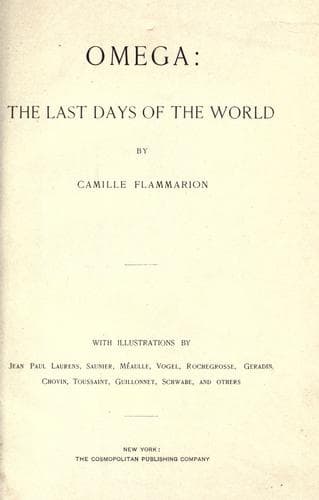
Omega: The Last days of the WorldFlammarion, Camille
Philosophy
Omega: The Last days of the World
Flammarion, Camille
End of the world -- Fiction; Science fiction
It was spring-time. There was no disorder. Innumerable marriages
followed. Russia and England had held aloof from the movement, the
suffrage of women in these countries not having been unanimous. But as
all the states of Europe were formed into a republic the ensuing year,
uniting in a single confederated state, on the invitation of the
government of the United States of Europe, these two great nations also
decreed a gradual disarmament. Long before this time, India had been
lost to England, and the latter had become a republic. As for Russia,
the monarchical form of government still existed. It was then the middle
of the twenty-fourth century, and from that epoch the narrow sentiment
of patriotism was replaced by the general one of humanity.
Delivery from the ball and chain of military slavery, Europe had
immediately gotten rid of the bureaucracy which had also exhausted
nations, condemned to perish, as it were, by plethora. But for this a
radical revolution was necessary. From that time on, Europe had advanced
as by magic in a marvellous progress—social, scientific, artistic and
industrial. Taxation, diminished by nine-tenths, served only for the
maintenance of internal order, the security of life and property, the
support of schools, and the encouragement of new researches. But
individual initiative was far more effective than the old-time official
centralization which for so many years had stifled individual effort,
and bureaucracy was dead and buried.
At last one breathed freely, one lived. In order to pay 700,000
millions every century to citizens withdrawn from all productive work,
and to maintain the bureaucracy, governments had been obliged to
increase taxation to a fearful degree. The result was that everything
was taxed; the air one breathes, the water one drinks, the light and
heat of the sun, bread, wine and every article of food, clothing,
houses, the streets of cities, the country roads, animals, horses,
oxen, dogs, cats, hens, rabbits, birds in cages, plants, flowers,
musical instruments, pianos, organs, violins, zithers, flutes,
trumpets, trades and professions, the married and the unmarried,
children, furniture—everything, absolutely everything; and this
taxation had grown until it equalled the net product of all human
labor, with the single exception of the “daily bread.” Then, all work
had ceased. It seemed thenceforth impossible to live. It was this
state of affairs which led to the great social revolution of the
international socialists, of which mention was made at the beginning
of this book, and to others which followed it. But these upheavals had
not definitely liberated Europe from the barbarism of bygone days, and
it was to the young women’s league that humanity owes its deliverance.
Public-domain text, read in full here on John Shaqi.
Reviews
Reviews
No reviews yet
Be the first to share your thoughts on this work.
Elsewhere in the archive
Join the Discussion
Join the discussion
Sign in to leave a comment or review.
Sign InorCreate an account