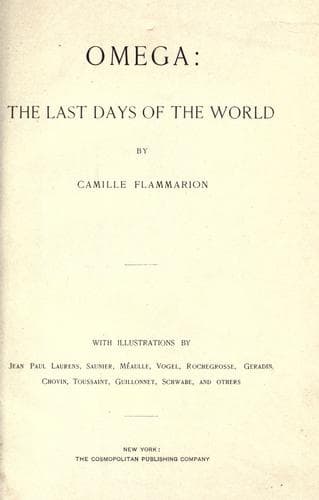
Omega: The Last days of the WorldFlammarion, Camille
Philosophy
Omega: The Last days of the World
Flammarion, Camille
End of the world -- Fiction; Science fiction
Humanity had tended towards unity, one race, one language, one general
government, one religion. There were no more state religions; only the
voice of an enlightened conscience, and in this unity former
anthropological differences had disappeared.
In former ages poets had prophesied that in the marvellous progress of
things man would finally acquire wings, and fly through the air by his
muscular force alone; but they had not studied the origin of
anthropomorphic structure and had forgotten that for a man to have at
the same time arms and wings, he must belong to a zoölogical order of
sextupeds which does not exist on our planet; for man belongs to the
quadrupeds, a type which has been gradually modified. But though he had
not acquired new natural organs, he had acquired artificial ones, to say
nothing of his physical transformation. He had conquered the region of
the air and could soar in the sky by light apparatus, whose motor power
was electricity, and the atmosphere had become his domain as it had been
that of the birds. It is very probable that if in the course of ages a
winged race could have acquired, by the development of its faculties of
observation, a brain analogous to that of even the most primitive man,
it would have soon dominated the human species and replaced it by a new
one,—a winged race of the same zoölogical type as the quadrupeds and
bipeds. But the force of gravity is an obstacle to any such organic
development of the winged species, and humanity, grown more perfect, had
remained master of the world.
At the same time, in the lapse of ages, the animal population of the
globe had completely changed. The wild species, lions, tigers, hyenas,
panthers, elephants, giraffes, kangaroos, as also whales and seals, had
become extinct.
[Illustration]
CHAPTER II.
[Illustration]
About the one hundredth century of the Christian era all resemblance
between the human race and monkeys had disappeared.
The nervous sensibility of man had become intensified to a marvellous
degree. The sense of sight, of hearing, of smell, of touch, and of
taste, had gradually acquired a delicacy far exceeding that of their
earlier and grosser manifestations. Through the study of the electrical
properties of living organisms, a seventh sense, the electric sense, was
created outright, so to speak; and everyone possessed the power of
attracting and repelling both living and inert matter, to a degree
depending upon the temperament of the individual. But by far the most
important of all the senses, the one which played the greatest role in
men’s relation to each other, was the eighth, the psychic sense, by
which communication at a distance became possible.
Public-domain text, read in full here on John Shaqi.
Reviews
Reviews
No reviews yet
Be the first to share your thoughts on this work.
Elsewhere in the archive
Join the Discussion
Join the discussion
Sign in to leave a comment or review.
Sign InorCreate an account