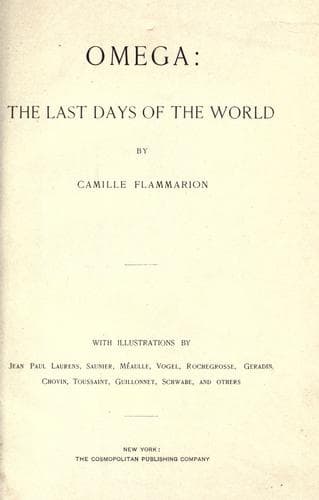
Omega: The Last days of the WorldFlammarion, Camille
Philosophy
Omega: The Last days of the World
Flammarion, Camille
End of the world -- Fiction; Science fiction
In the nineteenth century, researches in natural history had revealed
the fact that secular vertical oscillations, vary with the locality,
were taking place in the earth’s crust, and had proved that, from
prehistoric times, the soil of western and southern France had been
slowly sinking and the sea slowly gaining upon the land. One after
another, the islands of Jersey, of Minquiers, of Chaussey, of Écrehou,
of Cezembre, of Mont-Saint-Michel, had been detached from the
continent by the sea; the cities of Is, Helion, Tommen, Portzmeûr,
Harbour, Saint Louis, Monny, Bourgneuf, La Feillette, Paluel and
Nazado had been buried beneath its waves, and the Armorican peninsula
had slowly retreated before the advancing waters. The hour of this
invasion by the sea had struck, from century to century, also for
Herbavilla; to the west of Nantes; for Saint-Denis-Chef-de-Caux, to
the north of Havre; for Saint-Etienne-de-Paluel and for Gardoine, to
the north of Dol; for Tolente, to the west of Brest; more than eighty
habitable cities of Holland had been submerged in the eleventh
century, etc., etc. In other regions the reverse had taken place, and
the sea had retired; but to the north and west of Paris this double
action of the subsidence of the land and the wearing away of the
shores had, in less than seven thousand years, made Paris accessible
to ships of the greatest tonnage.
As in the case of languages, ideas, customs and laws, so, also, the
manner of reckoning time had changed. It was still reckoned by years and
centuries, but the Christian era had been discarded, as also the holy
days of the calendar and the eras of the Mussulman, Jewish, Chinese and
African chronologies. There was now a single calendar for the entire
race, composed of twelve months, divided into four equal trimesters of
three months of thirty-one, thirty, and thirty days, each trimester
containing exactly thirteen weeks. New Year’s Day was a fête day, and
was not reckoned in with the year; every bisextile year there were two.
The week had been retained. Every year commenced on the same day—Monday;
and the same dates always corresponded to the same days of the week. The
year began with the vernal equinox all over the world. The era, a purely
astronomical division of time, began with the coincidence of the
December solstice with perihelion, and was renewed every 25,765 years.
This rational method had succeeded the fantastic divisions of time
formerly in use.
Public-domain text, read in full here on John Shaqi.
Reviews
Reviews
No reviews yet
Be the first to share your thoughts on this work.
Elsewhere in the archive
Join the Discussion
Join the discussion
Sign in to leave a comment or review.
Sign InorCreate an account