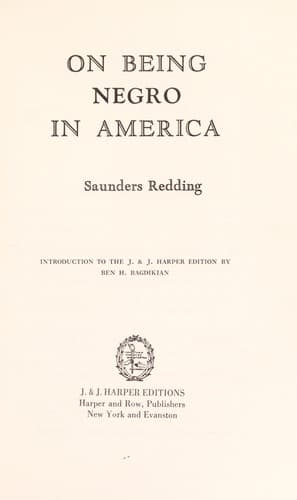
On Being Negro in AmericaRedding, J. Saunders (Jay Saunders)
General
On Being Negro in America
Redding, J. Saunders (Jay Saunders)
African Americans -- Race identity; Redding, J. Saunders (Jay Saunders), 1906-1988; United States -- Race relations
And before the ancient concepts crashed under the onslaught of
sophistication, of scientific materialism and the new philosophies it
brought into being, Christianity had become a way of life. It had become
a way of life to be striven for because it seemed to satisfy the needs
of ordinary men. There is nothing mysterious about Christianity. Granted
that mystery reposes in the life of Christ (as, let it be said, it did
not originally repose in God)—but Christ’s life and what he is reported
to have done are one thing: what he is reported to have taught is
another. What he taught is as clear and concrete and literal as the lead
story in a good newspaper. He taught that the kingdom of heaven is here
on earth. He preached that men should love one another. He said that all
men are brothers. He sought to bind men together in one mighty
neighborhood. He was, for all the mystery surrounding him, a social
engineer with a far and cosmic vision. The present age has not denied
that he was right. Though there are those (and I among them) who reject
the traditionally perpetuated events of his life as a factual record,
his ministry remains the source of Christian religion. What has happened
is that the age, while acknowledging Christianity as the highest way of
life that man has thus far conceived, has denied the authority of God to
make man live up to Christ’s teachings. The dream of God and the reality
of Christ have become separated.
If all this seems oversimplified, then I must again plead my lack of
resources for such speculation. I do not wish to give an appearance of
simplicity to problems that have taxed the best religious philosophers
of the past six hundred years. Theology quite aside, it seems to me that
the bearing which the Christian religion should have on human relations
throughout the world and on race relations in the Western world is
simple enough and direct enough. Perhaps it sounds somewhat effete to
say now, as William James said at the turn of the century, that life
becomes tiresome and meaningless unless it is constantly refreshed by
“communion with a wider self through which saving experiences come,” but
this seems to me to be true. The Christian religion offers that
communion with “a wider self.” It offers a mature approach to
experience. Modern man’s incredible good luck in escaping the direst
consequences of conduct unlighted by luminous beliefs and uncontrolled
by moral principles is fast running out. A third world war may destroy
man altogether—if, that is, he does not destroy himself in more subtle
and tortuous ways without war. It would be foolish optimism not to
assume the possibility of this.
It is not the nobility of Christ’s life that I would urge; it is the
practicality of his injunctions. It is more a matter of being sensible
than of being “good.” What I would see joined is the battle between
reason and superstition, progress and prejudice, order and chaos,
survival and destruction.
Public-domain text, read in full here on John Shaqi.
Reviews
Reviews
No reviews yet
Be the first to share your thoughts on this work.
Elsewhere in the archive
Join the Discussion
Join the discussion
Sign in to leave a comment or review.
Sign InorCreate an account