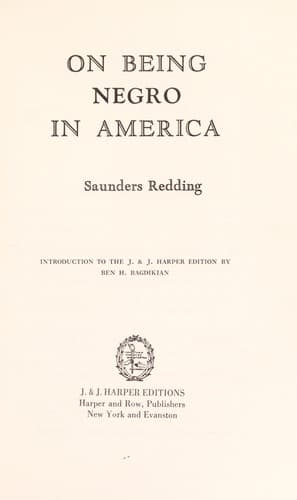
On Being Negro in AmericaRedding, J. Saunders (Jay Saunders)
General
On Being Negro in America
Redding, J. Saunders (Jay Saunders)
African Americans -- Race identity; Redding, J. Saunders (Jay Saunders), 1906-1988; United States -- Race relations
17
Now that I come to the end of this essay I realize that I have not done
for myself all that I had hoped to do. I am not purged: I am not cured
of my sickness. Perhaps it is not of the sort that can be cured by
individual home remedies. I thought that in the writing of this essay I
could pour myself out, in the manner of a Job or a Jeremiah, or through
a kind of free recall achieve the liberation and inner peace which
seemed so desirable. But even as I wrote I discovered that the very fact
of being Negro limited the freedom to pour myself out. I discovered
depths of self-consciousness and facets of experience that I simply
could not expose and that gave me feelings of shame to recognize as my
own. Not to write out these things was cowardly, of course, but no man
can tell the whole truth about himself, and the charge of cowardice is
easier to take than the traditional, detrusive charges of “Negro”
insensitivity, emotionalism, abandonment and self-pity. Moreover, what I
had to say about myself, if it made me appear bad and unprincipled,
would be taken as typical of the whole Negro race, and I found myself
being very conscious of this as I wrote. I doubt that race-consciousness
operates in this way in the work of white writers.
I like to think that I made a clear choice between telling the whole
truth and thus saving myself (which was my avowed original intent) and
not telling the whole truth and thus protecting the Negro race against
the prejudiced opinions which the whole truth would generate. But I know
this is pure rationalization. What I have done in this regard was not
the result of voluntary decision; it was, rather, evidence of the
relentless warping by a neurotic web of coercions, by the need to feel
responsible, by the need to have, even disingenuously and even though
limited, a sense of belonging and integration.
I have never wanted to be free of this need. I have never wanted to be
isolated or alienated, for my belief is that a commitment to something
outside oneself is necessary to human and humanistic development. I
expressed it long ago in another way: “I did not want sanctuary,” I
wrote, “a soft nest protected from the hard, strengthening winds that
blow hot and cold through the world’s teeming, turbulent valley. I
wanted to face the wind. I wanted the strength to face it to come from
some inexpressibly deep well of feeling of oneness with the wind, of
belonging to something, some soul-force outside myself, bigger than
myself, but yet a part of me. Not family merely, or institution, or
race; but a people and all their topless strivings; a nation and its
million destinies.”[14]
Public-domain text, read in full here on John Shaqi.
Reviews
Reviews
No reviews yet
Be the first to share your thoughts on this work.
Elsewhere in the archive
Join the Discussion
Join the discussion
Sign in to leave a comment or review.
Sign InorCreate an account