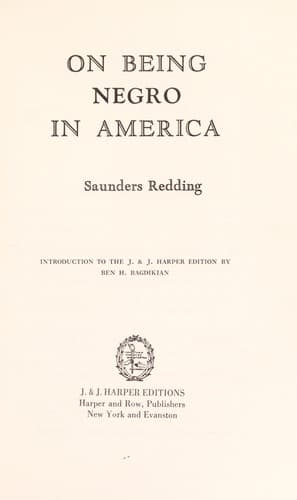
On Being Negro in AmericaRedding, J. Saunders (Jay Saunders)
General
On Being Negro in America
Redding, J. Saunders (Jay Saunders)
African Americans -- Race identity; Redding, J. Saunders (Jay Saunders), 1906-1988; United States -- Race relations
What I wanted (and still want—for the writing of this essay has not done
it) was to loose and shake off the confining coils of race and the
racial experience so that the integration—my personal integration and
commitment—can be made to something bigger than race, and more enduring,
and truer. For race is a myth: it is artificial; and it is, I hope, at
last a dying concept. Meantime, while it lives, it is also a barrier and
a terrible, terrible burden. It is a barrier to nearly everyone, white
and black, in America. It is a burden to everyone too, but it is a
personal burden to the Negro—a burden of shame and outrage imposed on
him at the earliest moment of consciousness and never lifted till death,
and all his energies, mental, emotional, spiritual, must be held in
reserve for carrying it.
Though I could not tell it, I saw the whole truth plain, and I think
perhaps this seeing helped at least to rid me of the illusion (temporary
at best) that there is something ennobling in being able to step aside
from the struggle race imposes, and that I would find inner security in
doing so. It was a pretty and an attractive illusion. If only I were not
Negro!—that, of course, was the impossible dream-wish on which the
illusion was founded. But I know now that there is no neutrality in
being white in America, and I have at least the comfort of knowing that
some white people too suffer from the limitations and frustrations of
“whiteness.” This was brought home to me more forcefully than ever since
I began this essay. This was the meaning, really, of a newspaper story
datelined “Brundidge, Ala., June 21 (1951)”: “An angry, armed band of
white farmers shot a Negro field worker today on the false rumor that he
had kidnapped a white woman. Forrest Jones ... was wounded ... by a
shotgun blast as he returned home after taking a white child, hurt in an
automobile accident, to a doctor’s office.”
A burden on the conscience and on the soul! This is what the books by
both Southern apologists and liberals mean. This is what Lillian Smith
and Hodding Carter and Howard Odum mean. I can even believe that John
Rankin and Richard Russell and James Byrnes and Strom Thurmond signify
this in their acts and in their words, and that Theodore Bilbo signified
this too. Whiteness does not mitigate the relentless warping by the race
situation in America. White men are half-men too—sick men, and perhaps
some of them the more to be pitied because they do not know that they
are sick. Some of them—the good, lucky ones, like Lillian Smith—have
succeeded somewhat in objectifying it; but neither for them nor for me
is there a neutral ground on which to stand. Neither they nor I can
resign from the human race. The best I can hope to do is to externalize
the struggle and set it in the unconfined context of the universal
struggle for human dignity and wholeness and unity.
Public-domain text, read in full here on John Shaqi.
Reviews
Reviews
No reviews yet
Be the first to share your thoughts on this work.
Elsewhere in the archive
Join the Discussion
Join the discussion
Sign in to leave a comment or review.
Sign InorCreate an account