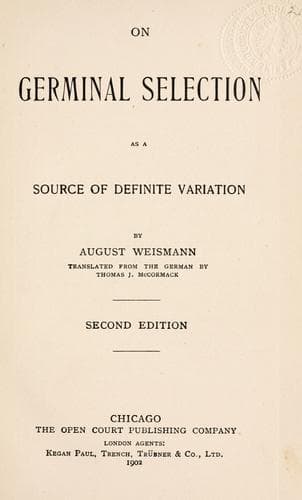
On Germinal Selection as a Source of Definite VariationWeismann, August
Science
On Germinal Selection as a Source of Definite Variation
Weismann, August
Variation (Biology)
dogma, and whoever ventures to disturb its foundations must be burnt as a
heretic.
[19] Oscar Hertwig, _Zeit- und Streitfragen der Biologie_, Jena, 1894.
[20] Nor will those, who demand a demonstration of "how the biophores and
determinants are constituted in every case, and must be arranged in the
architecture of the germ-plasm." (O. Hertwig, _loc. cit._, p. 137). As if
any living being could have the temerity even so much as to guess at the
actual ultimate phenomena in evolution and heredity! The whole question is
a matter of symbols only, just as it is in the matter of "forces," "atoms,"
"ether undulations," etc., the only difference being that in biology we
stumble much earlier upon the unknown than in physics.
[21] "Beitraege zur Kritik der Darwin'schen Lehre," _Biologisches
Centralblatt_, Vol. X., p. 449. 1890.
[22] Poulton has adverted to the fact that this is nevertheless not always
the case; for example, it is not so with the teeth, whose shape it had also
been sought to reduce to the mechanical effects of pressure and friction.
See "The Theory of Selection" in _The Proceedings of the Boston Society of
Natural History_, Vol. XX., page 389. 1894.
[23] As the highest stage of selective processes must be regarded that
between the highest biological units, the colonies or cormi--a stage,
however, which is not essentially different from personal selection. In
this stage the persons enact the part that the organs play in personal
selection. Like their prototypes they also battle with one another for food
and in this way maintain harmony in the colony. But the result of the
struggle endures only during the life of the individual colony and can be
transmitted through the germ-cells to the following generation as little as
can histological changes provoked by use in the individual person. Only
that which issues from the germ has duration.
[24] This statement has often been declared extravagant, and it is so if it
is taken in its strict literalness. On the other hand, it would also seem,
by a more liberal interpretation, as if there existed non-adaptive
characters, for example, rudimentary organs. Adaptiveness, however, is
never absolute but always conditioned, that is, is never greater than
outward and inward circumstances permit. Moreover, an organ can only
disappear gradually and slowly when it has become superfluous; yet this
does not prevent our recognising every stage of its degeneration as adapted
when compared with its precursor. Further, it does not militate against the
correctness of the above proposition that there are also characters whose
fitness consists in their being the necessary accompaniments of other
directly adapted features, as, for instance, the red color of the blood.
[25] Semper, _Die natuerlichen Existenzbedingungen der Thiere_, Leipsic,
1880, pp. 218-219.
Public-domain text, read in full here on John Shaqi.
Reviews
Reviews
No reviews yet
Be the first to share your thoughts on this work.
Elsewhere in the archive
Join the Discussion
Join the discussion
Sign in to leave a comment or review.
Sign InorCreate an account