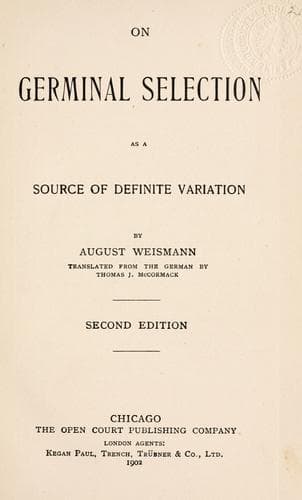
On Germinal Selection as a Source of Definite VariationWeismann, August
Science
On Germinal Selection as a Source of Definite Variation
Weismann, August
Variation (Biology)
[16] I speak here of determinants, not of groups of determinants, which is
the more correct expression, merely for the sake of brevity. It is a matter
of course that a whole extremity, such as we have here chosen, cannot be
represented in the germ by a single determinant only, but requires a large
group of determinants.
[17] That this is not so in all cases has recently been shown by Dixey from
observations on certain white butterflies of South America which mimic the
Heliconids and in which a small, yellowish red streak on the under surface
of the hind wing has served as the point of departure and groundwork of the
development of a protective resemblance to quite differently colored
Heliconids. "On the Relation of Mimetic Characters to the Original Form,"
in the _Report of the British Association for 1894_.
[18] Oscar Hertwig, _Zeit-und Streitfragen der Biologie_, Jena, 1894. It is
customary now to look upon the preformation-theory of Bonnet as a discarded
monstrosity, and on the epigenesis of K. F. Wolff as the only legitimate
view, and to draw a parallel between these two and what might be called
to-day "evolution" [i. e. unfoldment] and epigenesis. The evolution, or
unfoldment, of Bonnet and Harvey, however, was something totally different
from modern doctrines of evolution, and Whitman is quite right when he says
that even my theory of determinants would have appeared to the inquirers of
the last century as "extravagant epigenesis." Biologists in that day were
concerned with quite different questions from what they are at present, and
although now we probably all share the conviction of Wolff that new
characters do arise in the course of evolution, yet the acceptance of this
view is far from settling the question _as to how these new characters are
established in the germ-substance_--for in this substance they certainly
must have their foundation. When, therefore, O. Hertwig laments over my
regarding evolution and not epigenesis as the correct foundation of the
theory of development, his sorrow is almost as naive as is the statement of
Bourne that epigenesis is a fact and not a theory "a statement of
morphological fact," _Science Progress_, April, 1894, page 108), or, as is
the latter's unconsciousness that facts originally receive their scientific
significance from thought, i. e. from their interpretation and combination,
and that thought is theory. And when S. Minot, as the leader of the
embryologists, carries his zeal to the pitch of issuing a general
pronunciamento against me as a corruptor of youth, in which he declares it
to be a "scientific duty to protest in the most positive manner against
Weismann's theory," I wonder greatly that he does not suggest the casting
of a general ballot in the matter. (See the _Biologisches Centralblatt_ of
August 1, 1895.) We see how with these gentlemen the wisdom of the
recitation-room regarding the infallibility of epigenesis has grown into a
Public-domain text, read in full here on John Shaqi.
Reviews
Reviews
No reviews yet
Be the first to share your thoughts on this work.
Elsewhere in the archive
Join the Discussion
Join the discussion
Sign in to leave a comment or review.
Sign InorCreate an account