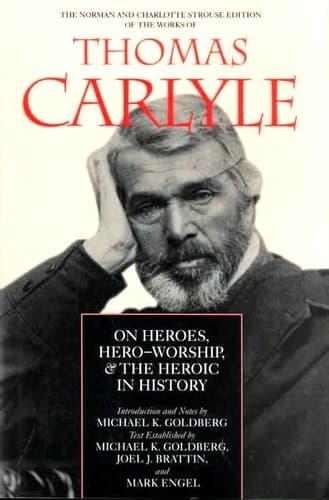
On Heroes, Hero-Worship, and the Heroic in HistoryCarlyle, Thomas
Philosophy
On Heroes, Hero-Worship, and the Heroic in History
Carlyle, Thomas
Hero worship; Heroes
But here enters the fatal circumstance of Idolatry, that, in the era
of the Prophets, no man's mind _is_ any longer honestly filled with his
Idol or Symbol. Before the Prophet can arise who, seeing through it,
knows it to be mere wood, many men must have begun dimly to doubt that
it was little more. Condemnable Idolatry is _insincere_ Idolatry.
Doubt has eaten out the heart of it: a human soul is seen clinging
spasmodically to an Ark of the Covenant, which it half feels now to have
become a Phantasm. This is one of the balefulest sights. Souls are no
longer filled with their Fetish; but only pretend to be filled, and
would fain make themselves feel that they are filled. "You do not
believe," said Coleridge; "you only believe that you believe." It is the
final scene in all kinds of Worship and Symbolism; the sure symptom
that death is now nigh. It is equivalent to what we call Formulism, and
Worship of Formulas, in these days of ours. No more immoral act can be
done by a human creature; for it is the beginning of all immorality, or
rather it is the impossibility henceforth of any morality whatsoever:
the innermost moral soul is paralyzed thereby, cast into fatal magnetic
sleep! Men are no longer _sincere_ men. I do not wonder that the earnest
man denounces this, brands it, prosecutes it with inextinguishable
aversion. He and it, all good and it, are at death-feud. Blamable
Idolatry is _Cant_, and even what one may call Sincere-Cant.
Sincere-Cant: that is worth thinking of! Every sort of Worship ends with
this phasis.
I find Luther to have been a Breaker of Idols, no less than any other
Prophet. The wooden gods of the Koreish, made of timber and bees-wax,
were not more hateful to Mahomet than Tetzel's Pardons of Sin, made of
sheepskin and ink, were to Luther. It is the property of every Hero, in
every time, in every place and situation, that he come back to reality;
that he stand upon things, and not shows of things. According as he
loves, and venerates, articulately or with deep speechless thought, the
awful realities of things, so will the hollow shows of things, however
regular, decorous, accredited by Koreishes or Conclaves, be intolerable
and detestable to him. Protestantism, too, is the work of a Prophet:
the prophet-work of that sixteenth century. The first stroke of honest
demolition to an ancient thing grown false and idolatrous; preparatory
afar off to a new thing, which shall be true, and authentically divine!
Public-domain text, read in full here on John Shaqi.
Reviews
Reviews
No reviews yet
Be the first to share your thoughts on this work.
Elsewhere in the archive
Join the Discussion
Join the discussion
Sign in to leave a comment or review.
Sign InorCreate an account