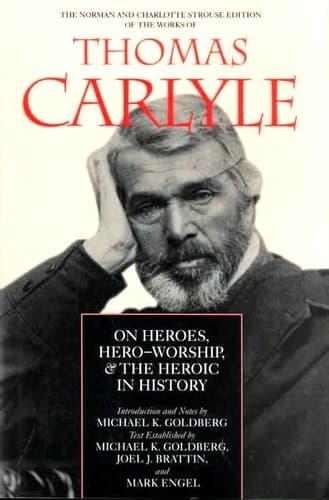
On Heroes, Hero-Worship, and the Heroic in HistoryCarlyle, Thomas
Philosophy
On Heroes, Hero-Worship, and the Heroic in History
Carlyle, Thomas
Hero worship; Heroes
The Diet of Worms, Luther's appearance there on the 17th of April, 1521,
may be considered as the greatest scene in Modern European History; the
point, indeed, from which the whole subsequent history of civilization
takes its rise. After multiplied negotiations, disputations, it had
come to this. The young Emperor Charles Fifth, with all the Princes
of Germany, Papal nuncios, dignitaries spiritual and temporal, are
assembled there: Luther is to appear and answer for himself, whether he
will recant or not. The world's pomp and power sits there on this
hand: on that, stands up for God's Truth, one man, the poor miner Hans
Luther's Son. Friends had reminded him of Huss, advised him not to go;
he would not be advised. A large company of friends rode out to meet
him, with still more earnest warnings; he answered, "Were there as many
Devils in Worms as there are roof-tiles, I would on." The people, on
the morrow, as he went to the Hall of the Diet, crowded the windows and
house-tops, some of them calling out to him, in solemn words, not to
recant: "Whosoever denieth me before men!" they cried to him,--as in
a kind of solemn petition and adjuration. Was it not in reality our
petition too, the petition of the whole world, lying in dark bondage
of soul, paralyzed under a black spectral Nightmare and triple-hatted
Chimera, calling itself Father in God, and what not: "Free us; it rests
with thee; desert us not!"
Luther did not desert us. His speech, of two hours, distinguished itself
by its respectful, wise and honest tone; submissive to whatsoever could
lawfully claim submission, not submissive to any more than that. His
writings, he said, were partly his own, partly derived from the Word of
God. As to what was his own, human infirmity entered into it; unguarded
anger, blindness, many things doubtless which it were a blessing for him
could he abolish altogether. But as to what stood on sound truth and
the Word of God, he could not recant it. How could he? "Confute me," he
concluded, "by proofs of Scripture, or else by plain just arguments: I
cannot recant otherwise. For it is neither safe nor prudent to do aught
against conscience. Here stand I; I can do no other: God assist me!"--It
is, as we say, the greatest moment in the Modern History of Men. English
Puritanism, England and its Parliaments, Americas, and vast work these
two centuries; French Revolution, Europe and its work everywhere at
present: the germ of it all lay there: had Luther in that moment done
other, it had all been otherwise! The European World was asking him:
Am I to sink ever lower into falsehood, stagnant putrescence, loathsome
accursed death; or, with whatever paroxysm, to cast the falsehoods out
of me, and be cured and live?--
Public-domain text, read in full here on John Shaqi.
Reviews
Reviews
No reviews yet
Be the first to share your thoughts on this work.
Elsewhere in the archive
Join the Discussion
Join the discussion
Sign in to leave a comment or review.
Sign InorCreate an account