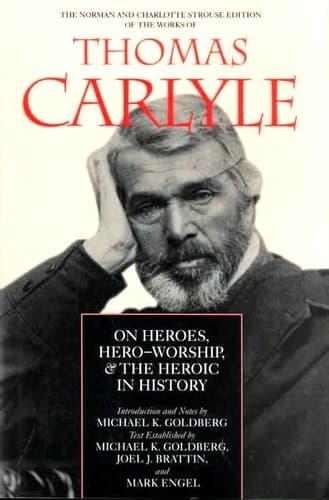
On Heroes, Hero-Worship, and the Heroic in HistoryCarlyle, Thomas
Philosophy
On Heroes, Hero-Worship, and the Heroic in History
Carlyle, Thomas
Hero worship; Heroes
Of Luther I will add now, in reference to all these wars and bloodshed,
the noticeable fact that none of them began so long as he continued
living. The controversy did not get to fighting so long as he was there.
To me it is proof of his greatness in all senses, this fact. How seldom
do we find a man that has stirred up some vast commotion, who does
not himself perish, swept away in it! Such is the usual course of
revolutionists. Luther continued, in a good degree, sovereign of this
greatest revolution; all Protestants, of what rank or function soever,
looking much to him for guidance: and he held it peaceable, continued
firm at the centre of it. A man to do this must have a kingly faculty:
he must have the gift to discern at all turns where the true heart of
the matter lies, and to plant himself courageously on that, as a strong
true man, that other true men may rally round him there. He will not
continue leader of men otherwise. Luther's clear deep force of judgment,
his force of all sorts, of _silence_, of tolerance and moderation, among
others, are very notable in these circumstances.
Tolerance, I say; a very genuine kind of tolerance: he distinguishes
what is essential, and what is not; the unessential may go very much as
it will. A complaint comes to him that such and such a Reformed Preacher
"will not preach without a cassock." Well, answers Luther, what harm
will a cassock do the man? "Let him have a cassock to preach in; let
him have three cassocks if he find benefit in them!" His conduct in the
matter of Karlstadt's wild image-breaking; of the Anabaptists; of the
Peasants' War, shows a noble strength, very different from spasmodic
violence. With sure prompt insight he discriminates what is what: a
strong just man, he speaks forth what is the wise course, and all men
follow him in that. Luther's Written Works give similar testimony of
him. The dialect of these speculations is now grown obsolete for us;
but one still reads them with a singular attraction. And indeed the mere
grammatical diction is still legible enough; Luther's merit in literary
history is of the greatest: his dialect became the language of all
writing. They are not well written, these Four-and-twenty Quartos of
his; written hastily, with quite other than literary objects. But in no
Books have I found a more robust, genuine, I will say noble faculty of
a man than in these. A rugged honesty, homeliness, simplicity; a rugged
sterling sense and strength. He dashes out illumination from him; his
smiting idiomatic phrases seem to cleave into the very secret of the
matter. Good humor too, nay tender affection, nobleness and depth: this
man could have been a Poet too! He had to _work_ an Epic Poem, not
write one. I call him a great Thinker; as indeed his greatness of heart
already betokens that.
Public-domain text, read in full here on John Shaqi.
Reviews
Reviews
No reviews yet
Be the first to share your thoughts on this work.
Elsewhere in the archive
Join the Discussion
Join the discussion
Sign in to leave a comment or review.
Sign InorCreate an account