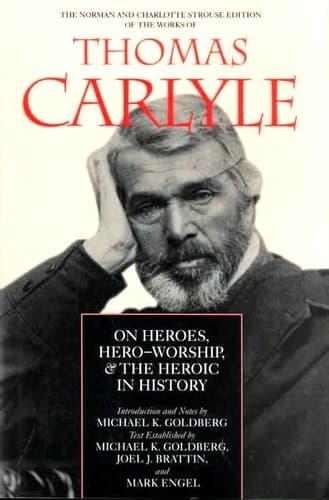
On Heroes, Hero-Worship, and the Heroic in HistoryCarlyle, Thomas
Philosophy
On Heroes, Hero-Worship, and the Heroic in History
Carlyle, Thomas
Hero worship; Heroes
For one thing, I will remark that this post of Prophet to his Nation was
not of his seeking; Knox had lived forty years quietly obscure, before
he became conspicuous. He was the son of poor parents; had got a college
education; become a Priest; adopted the Reformation, and seemed well
content to guide his own steps by the light of it, nowise unduly
intruding it on others. He had lived as Tutor in gentlemen's families;
preaching when any body of persons wished to hear his doctrine: resolute
he to walk by the truth, and speak the truth when called to do it;
not ambitious of more; not fancying himself capable of more. In this
entirely obscure way he had reached the age of forty; was with the small
body of Reformers who were standing siege in St. Andrew's Castle,--when
one day in their chapel, the Preacher after finishing his exhortation to
these fighters in the forlorn hope, said suddenly, That there ought to
be other speakers, that all men who had a priest's heart and gift in
them ought now to speak;--which gifts and heart one of their own number,
John Knox the name of him, had: Had he not? said the Preacher, appealing
to all the audience: what then is _his_ duty? The people answered
affirmatively; it was a criminal forsaking of his post, if such a man
held the word that was in him silent. Poor Knox was obliged to stand
up; he attempted to reply; he could say no word;--burst into a flood
of tears, and ran out. It is worth remembering, that scene. He was in
grievous trouble for some days. He felt what a small faculty was his
for this great work. He felt what a baptism he was called to be baptized
withal. He "burst into tears."
Our primary characteristic of a Hero, that he is sincere, applies
emphatically to Knox. It is not denied anywhere that this, whatever
might be his other qualities or faults, is among the truest of men. With
a singular instinct he holds to the truth and fact; the truth alone is
there for him, the rest a mere shadow and deceptive nonentity. However
feeble, forlorn the reality may seem, on that and that only _can_ he
take his stand. In the Galleys of the River Loire, whither Knox and the
others, after their Castle of St. Andrew's was taken, had been sent as
Galley-slaves,--some officer or priest, one day, presented them an Image
of the Virgin Mother, requiring that they, the blasphemous heretics,
should do it reverence. Mother? Mother of God? said Knox, when the turn
came to him: This is no Mother of God: this is "_a pented bredd_,"--_a_
piece of wood, I tell you, with paint on it! She is fitter for swimming,
I think, than for being worshipped, added Knox; and flung the thing
into the river. It was not very cheap jesting there: but come of it what
might, this thing to Knox was and must continue nothing other than the
real truth; it was a _pented bredd_: worship it he would not.
Public-domain text, read in full here on John Shaqi.
Reviews
Reviews
No reviews yet
Be the first to share your thoughts on this work.
Elsewhere in the archive
Join the Discussion
Join the discussion
Sign in to leave a comment or review.
Sign InorCreate an account