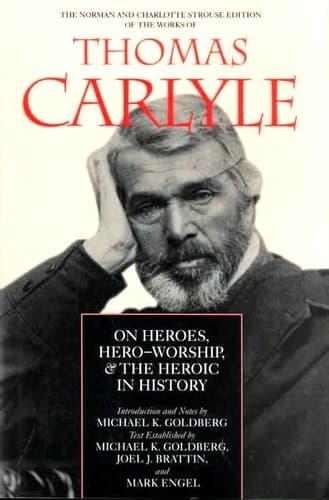
On Heroes, Hero-Worship, and the Heroic in HistoryCarlyle, Thomas
Philosophy
On Heroes, Hero-Worship, and the Heroic in History
Carlyle, Thomas
Hero worship; Heroes
There are genuine Men of Letters, and not genuine; as in every kind
there is a genuine and a spurious. If _hero_ be taken to mean genuine,
then I say the Hero as Man of Letters will be found discharging a
function for us which is ever honorable, ever the highest; and was once
well known to be the highest. He is uttering forth, in such way as he
has, the inspired soul of him; all that a man, in any case, can do. I
say _inspired_; for what we call "originality," "sincerity," "genius,"
the heroic quality we have no good name for, signifies that. The Hero
is he who lives in the inward sphere of things, in the True, Divine
and Eternal, which exists always, unseen to most, under the Temporary,
Trivial: his being is in that; he declares that abroad, by act or speech
as it may be in declaring himself abroad. His life, as we said before,
is a piece of the everlasting heart of Nature herself: all men's life
is,--but the weak many know not the fact, and are untrue to it, in most
times; the strong few are strong, heroic, perennial, because it cannot
be hidden from them. The Man of Letters, like every Hero, is there
to proclaim this in such sort as he can. Intrinsically it is the same
function which the old generations named a man Prophet, Priest, Divinity
for doing; which all manner of Heroes, by speech or by act, are sent
into the world to do.
Fichte the German Philosopher delivered, some forty years ago at
Erlangen, a highly remarkable Course of Lectures on this subject:
"_Ueber das Wesen des Gelehrten_, On the Nature of the Literary Man."
Fichte, in conformity with the Transcendental Philosophy, of which he
was a distinguished teacher, declares first: That all things which we
see or work with in this Earth, especially we ourselves and all persons,
are as a kind of vesture or sensuous Appearance: that under all there
lies, as the essence of them, what he calls the "Divine Idea of
the World;" this is the Reality which "lies at the bottom of all
Appearance." To the mass of men no such Divine Idea is recognizable in
the world; they live merely, says Fichte, among the superficialities,
practicalities and shows of the world, not dreaming that there is
anything divine under them. But the Man of Letters is sent hither
specially that he may discern for himself, and make manifest to us, this
same Divine Idea: in every new generation it will manifest itself in
a new dialect; and he is there for the purpose of doing that. Such is
Fichte's phraseology; with which we need not quarrel. It is his way of
naming what I here, by other words, am striving imperfectly to
name; what there is at present no name for: The unspeakable Divine
Significance, full of splendor, of wonder and terror, that lies in the
being of every man, of every thing,--the Presence of the God who made
every man and thing. Mahomet taught this in his dialect; Odin in his: it
is the thing which all thinking hearts, in one dialect or another, are
here to teach.
Public-domain text, read in full here on John Shaqi.
Reviews
Reviews
No reviews yet
Be the first to share your thoughts on this work.
Elsewhere in the archive
Join the Discussion
Join the discussion
Sign in to leave a comment or review.
Sign InorCreate an account