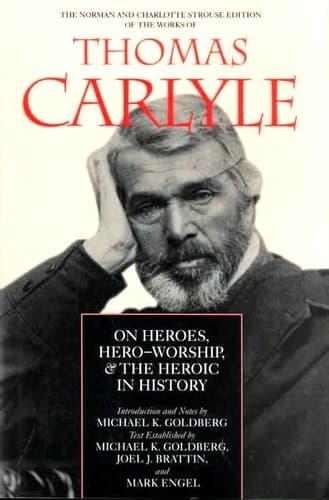
On Heroes, Hero-Worship, and the Heroic in HistoryCarlyle, Thomas
Philosophy
On Heroes, Hero-Worship, and the Heroic in History
Carlyle, Thomas
Hero worship; Heroes
Belief I define to be the healthy act of a man's mind. It
is a mysterious indescribable process, that of getting to
believe;--indescribable, as all vital acts are. We have our mind given
us, not that it may cavil and argue, but that it may see into something,
give us clear belief and understanding about something, whereon we are
then to proceed to act. Doubt, truly, is not itself a crime. Certainly
we do not rush out, clutch up the first thing we find, and straightway
believe that! All manner of doubt, inquiry, [Gr.] _skepsis_ as it is
named, about all manner of objects, dwells in every reasonable mind. It
is the mystic working of the mind, on the object it is _getting_ to know
and believe. Belief comes out of all this, above ground, like the tree
from its hidden _roots_. But now if, even on common things, we require
that a man keep his doubts _silent_, and not babble of them till they in
some measure become affirmations or denials; how much more in regard to
the highest things, impossible to speak of in words at all! That a man
parade his doubt, and get to imagine that debating and logic (which
means at best only the manner of _telling_ us your thought, your belief
or disbelief, about a thing) is the triumph and true work of what
intellect he has: alas, this is as if you should _overturn_ the tree,
and instead of green boughs, leaves and fruits, show us ugly taloned
roots turned up into the air,--and no growth, only death and misery
going on!
For the Scepticism, as I said, is not intellectual only; it is moral
also; a chronic atrophy and disease of the whole soul. A man lives by
believing something; not by debating and arguing about many things. A
sad case for him when all that he can manage to believe is something
he can button in his pocket, and with one or the other organ eat and
digest! Lower than that he will not get. We call those ages in which
he gets so low the mournfulest, sickest and meanest of all ages. The
world's heart is palsied, sick: how can any limb of it be whole?
Genuine Acting ceases in all departments of the world's work; dexterous
Similitude of Acting begins. The world's wages are pocketed, the
world's work is not done. Heroes have gone out; Quacks have come in.
Accordingly, what Century, since the end of the Roman world, which also
was a time of scepticism, simulacra and universal decadence, so
abounds with Quacks as that Eighteenth? Consider them, with their
tumid sentimental vaporing about virtue, benevolence,--the wretched
Quack-squadron, Cagliostro at the head of them! Few men were without
quackery; they had got to consider it a necessary ingredient and amalgam
for truth. Chatham, our brave Chatham himself, comes down to the House,
all wrapt and bandaged; he "has crawled out in great bodily suffering,"
and so on;--_forgets_, says Walpole, that he is acting the sick man; in
the fire of debate, snatches his arm from the sling, and oratorically
swings and brandishes it! Chatham himself lives the strangest mimetic
Public-domain text, read in full here on John Shaqi.
Reviews
Reviews
No reviews yet
Be the first to share your thoughts on this work.
Elsewhere in the archive
Join the Discussion
Join the discussion
Sign in to leave a comment or review.
Sign InorCreate an account