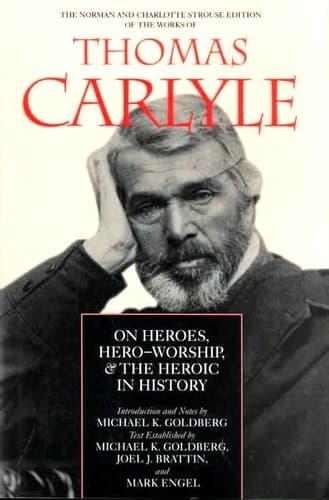
On Heroes, Hero-Worship, and the Heroic in HistoryCarlyle, Thomas
Philosophy
On Heroes, Hero-Worship, and the Heroic in History
Carlyle, Thomas
Hero worship; Heroes
I have already written of these three Literary Heroes, expressly or
incidentally; what I suppose is known to most of you; what need not be
spoken or written a second time. They concern us here as the singular
_Prophets_ of that singular age; for such they virtually were; and the
aspect they and their world exhibit, under this point of view, might
lead us into reflections enough! I call them, all three, Genuine Men
more or less; faithfully, for most part unconsciously, struggling to be
genuine, and plant themselves on the everlasting truth of things. This
to a degree that eminently distinguishes them from the poor artificial
mass of their contemporaries; and renders them worthy to be considered
as Speakers, in some measure, of the everlasting truth, as Prophets in
that age of theirs. By Nature herself a noble necessity was laid on them
to be so. They were men of such magnitude that they could not live on
unrealities,--clouds, froth and all inanity gave way under them: there
was no footing for them but on firm earth; no rest or regular motion for
them, if they got not footing there. To a certain extent, they were Sons
of Nature once more in an age of Artifice; once more, Original Men.
As for Johnson, I have always considered him to be, by nature, one
of our great English souls. A strong and noble man; so much left
undeveloped in him to the last: in a kindlier element what might he not
have been,--Poet, Priest, sovereign Ruler! On the whole, a man must not
complain of his "element," of his "time," or the like; it is thriftless
work doing so. His time is bad: well then, he is there to make it
better!--Johnson's youth was poor, isolated, hopeless, very miserable.
Indeed, it does not seem possible that, in any the favorablest outward
circumstances, Johnson's life could have been other than a painful one.
The world might have had more of profitable _work_ out of him, or less;
but his _effort_ against the world's work could never have been a light
one. Nature, in return for his nobleness, had said to him, Live in an
element of diseased sorrow. Nay, perhaps the sorrow and the nobleness
were intimately and even inseparably connected with each other. At all
events, poor Johnson had to go about girt with continual hypochondria,
physical and spiritual pain. Like a Hercules with the burning
Nessus'-shirt on him, which shoots in on him dull incurable misery: the
Nessus'-shirt not to be stript off, which is his own natural skin! In
this manner _he_ had to live. Figure him there, with his scrofulous
diseases, with his great greedy heart, and unspeakable chaos of
thoughts; stalking mournful as a stranger in this Earth; eagerly
devouring what spiritual thing he could come at: school-languages
and other merely grammatical stuff, if there were nothing better! The
largest soul that was in all England; and provision made for it of
"fourpence-halfpenny a day." Yet a giant invincible soul; a true man's.
Public-domain text, read in full here on John Shaqi.
Reviews
Reviews
No reviews yet
Be the first to share your thoughts on this work.
Elsewhere in the archive
Join the Discussion
Join the discussion
Sign in to leave a comment or review.
Sign InorCreate an account