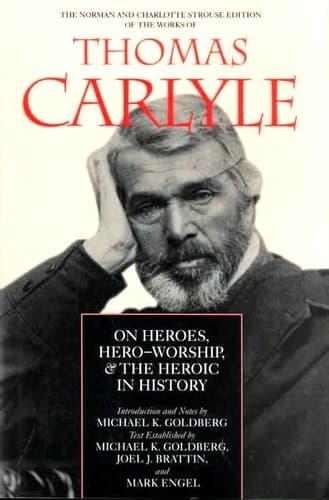
On Heroes, Hero-Worship, and the Heroic in HistoryCarlyle, Thomas
Philosophy
On Heroes, Hero-Worship, and the Heroic in History
Carlyle, Thomas
Hero worship; Heroes
My last remark is on that notablest phasis of Burns's history,--his
visit to Edinburgh. Often it seems to me as if his demeanor there were
the highest proof he gave of what a fund of worth and genuine manhood
was in him. If we think of it, few heavier burdens could be laid on
the strength of a man. So sudden; all common _Lionism_. which ruins
innumerable men, was as nothing to this. It is as if Napoleon had
been made a King of, not gradually, but at once from the Artillery
Lieutenancy in the Regiment La Fere. Burns, still only in his
twenty-seventh year, is no longer even a ploughman; he is flying to the
West Indies to escape disgrace and a jail. This month he is a ruined
peasant, his wages seven pounds a year, and these gone from him: next
month he is in the blaze of rank and beauty, handing down jewelled
Duchesses to dinner; the cynosure of all eyes! Adversity is sometimes
hard upon a man; but for one man who can stand prosperity, there are a
hundred that will stand adversity. I admire much the way in which Burns
met all this. Perhaps no man one could point out, was ever so sorely
tried, and so little forgot himself. Tranquil, unastonished; not
abashed, not inflated, neither awkwardness nor affectation: he feels
that _he_ there is the man Robert Burns; that the "rank is but the
guinea-stamp;" that the celebrity is but the candle-light, which will
show _what_ man, not in the least make him a better or other man! Alas,
it may readily, unless he look to it, make him a _worse_ man; a wretched
inflated wind-bag,--inflated till he _burst_, and become a _dead_ lion;
for whom, as some one has said, "there is no resurrection of the body;"
worse than a living dog!--Burns is admirable here.
And yet, alas, as I have observed elsewhere, these Lion-hunters were the
ruin and death of Burns. It was they that rendered it impossible for him
to live! They gathered round him in his Farm; hindered his industry;
no place was remote enough from them. He could not get his Lionism
forgotten, honestly as he was disposed to do so. He falls into
discontents, into miseries, faults; the world getting ever more desolate
for him; health, character, peace of mind, all gone;--solitary enough
now. It is tragical to think of! These men came but to _see_ him; it was
out of no sympathy with him, nor no hatred to him. They came to get a
little amusement; they got their amusement;--and the Hero's life went
for it!
Richter says, in the Island of Sumatra there is a kind of
"Light-chafers," large Fire-flies, which people stick upon spits, and
illuminate the ways with at night. Persons of condition can thus travel
with a pleasant radiance, which they much admire. Great honor to the
Fire-flies! But--!
LECTURE VI. THE HERO AS KING. CROMWELL, NAPOLEON: MODERN REVOLUTIONISM.
[May 22, 1840.]
Public-domain text, read in full here on John Shaqi.
Reviews
Reviews
No reviews yet
Be the first to share your thoughts on this work.
Elsewhere in the archive
Join the Discussion
Join the discussion
Sign in to leave a comment or review.
Sign InorCreate an account