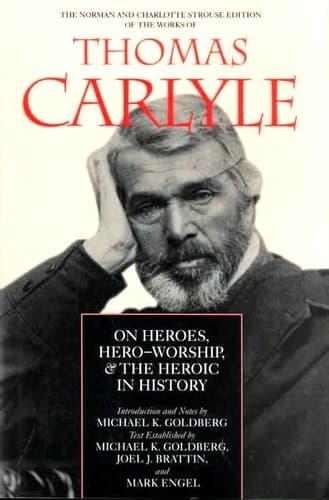
On Heroes, Hero-Worship, and the Heroic in HistoryCarlyle, Thomas
Philosophy
On Heroes, Hero-Worship, and the Heroic in History
Carlyle, Thomas
Hero worship; Heroes
Thus too all human things, maddest French Sansculottisms, do and must
work towards Order. I say, there is not a _man_ in them, raging in the
thickest of the madness, but is impelled withal, at all moments, towards
Order. His very life means that; Disorder is dissolution, death. No
chaos but it seeks a _centre_ to revolve round. While man is
man, some Cromwell or Napoleon is the necessary finish of a
Sansculottism.--Curious: in those days when Hero-worship was the most
incredible thing to every one, how it does come out nevertheless, and
assert itself practically, in a way which all have to credit. Divine
_right_, take it on the great scale, is found to mean divine _might_
withal! While old false Formulas are getting trampled everywhere into
destruction, new genuine Substances unexpectedly unfold themselves
indestructible. In rebellious ages, when Kingship itself seems dead and
abolished, Cromwell, Napoleon step forth again as Kings. The history of
these men is what we have now to look at, as our last phasis of Heroism.
The old ages are brought back to us; the manner in which Kings were
made, and Kingship itself first took rise, is again exhibited in the
history of these Two.
We have had many civil wars in England; wars of Red and White Roses,
wars of Simon de Montfort; wars enough, which are not very memorable.
But that war of the Puritans has a significance which belongs to no one
of the others. Trusting to your candor, which will suggest on the other
side what I have not room to say, I will call it a section once more of
that great universal war which alone makes up the true History of the
World,--the war of Belief against Unbelief! The struggle of men intent
on the real essence of things, against men intent on the semblances and
forms of things. The Puritans, to many, seem mere savage Iconoclasts,
fierce destroyers of Forms; but it were more just to call them haters of
_untrue_ Forms. I hope we know how to respect Laud and his King as well
as them. Poor Laud seems to me to have been weak and ill-starred, not
dishonest an unfortunate Pedant rather than anything worse. His "Dreams"
and superstitions, at which they laugh so, have an affectionate, lovable
kind of character. He is like a College-Tutor, whose whole world is
forms, College-rules; whose notion is that these are the life and safety
of the world. He is placed suddenly, with that unalterable luckless
notion of his, at the head not of a College but of a Nation, to regulate
the most complex deep-reaching interests of men. He thinks they ought to
go by the old decent regulations; nay that their salvation will lie in
extending and improving these. Like a weak man, he drives with spasmodic
vehemence towards his purpose; cramps himself to it, heeding no voice of
prudence, no cry of pity: He will have his College-rules obeyed by his
Collegians; that first; and till that, nothing. He is an ill-starred
Pedant, as I said. He would have it the world was a College of that
Public-domain text, read in full here on John Shaqi.
Reviews
Reviews
No reviews yet
Be the first to share your thoughts on this work.
Elsewhere in the archive
Join the Discussion
Join the discussion
Sign in to leave a comment or review.
Sign InorCreate an account