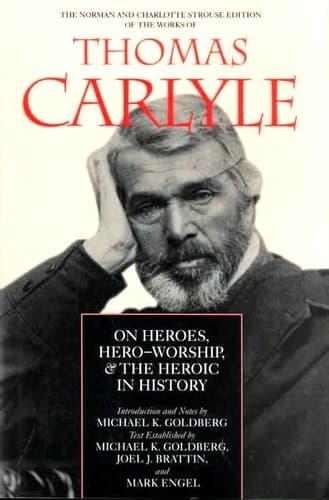
On Heroes, Hero-Worship, and the Heroic in HistoryCarlyle, Thomas
Philosophy
On Heroes, Hero-Worship, and the Heroic in History
Carlyle, Thomas
Hero worship; Heroes
And indeed, as these things became gradually manifest, the character
of the Puritans began to clear itself. Their memories were, one after
another, taken _down_ from the gibbet; nay a certain portion of them
are now, in these days, as good as canonized. Eliot, Hampden, Pym, nay
Ludlow, Hutchinson, Vane himself, are admitted to be a kind of Heroes;
political Conscript Fathers, to whom in no small degree we owe what
makes us a free England: it would not be safe for anybody to designate
these men as wicked now. Few Puritans of note but find their apologists
somewhere, and have a certain reverence paid them by earnest men. One
Puritan, I think, and almost he alone, our poor Cromwell, seems to hang
yet on the gibbet, and find no hearty apologist anywhere. Him neither
saint nor sinner will acquit of great wickedness. A man of ability,
infinite talent, courage, and so forth: but he betrayed the Cause.
Selfish ambition, dishonesty, duplicity; a fierce, coarse, hypocritical
_Tartuffe_; turning all that noble Struggle for constitutional Liberty
into a sorry farce played for his own benefit: this and worse is the
character they give of Cromwell. And then there come contrasts with
Washington and others; above all, with these noble Pyms and Hampdens,
whose noble work he stole for himself, and ruined into a futility and
deformity.
This view of Cromwell seems to me the not unnatural product of a century
like the Eighteenth. As we said of the Valet, so of the Sceptic: He does
not know a Hero when he sees him! The Valet expected purple mantles,
gilt sceptres, bodyguards and flourishes of trumpets: the Sceptic of
the Eighteenth century looks for regulated respectable Formulas,
"Principles," or what else he may call them; a style of speech and
conduct which has got to seem "respectable," which can plead for
itself in a handsome articulate manner, and gain the suffrages of an
enlightened sceptical Eighteenth century! It is, at bottom, the
same thing that both the Valet and he expect: the garnitures of some
_acknowledged_ royalty, which _then_ they will acknowledge! The King
coming to them in the rugged _un_formulistic state shall be no King.
Public-domain text, read in full here on John Shaqi.
Reviews
Reviews
No reviews yet
Be the first to share your thoughts on this work.
Elsewhere in the archive
Join the Discussion
Join the discussion
Sign in to leave a comment or review.
Sign InorCreate an account