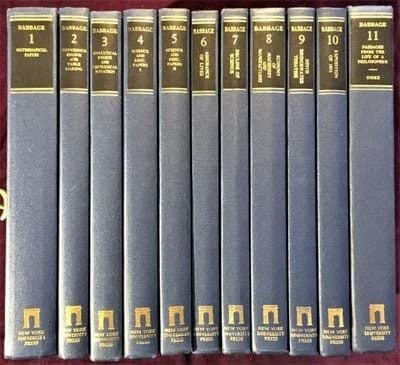
On the Economy of Machinery and ManufacturesBabbage, Charles
ReligionComparative
On the Economy of Machinery and Manufactures
Babbage, Charles
Machinery; Manufactures
207. If we wish to compare the value of any article at
different periods of time, it is clear that neither any one
substance, nor even the combination of all manufactured goods,
can furnish us with an invariable unit by which to form our scale
of estimation. Mr Malthus has proposed for this purpose to
consider a day's labour of an agricultural labourer, as the unit
to which all value should be referred. Thus, if we wish to
compare the value of twenty yards of broad cloth in Saxony at the
present time, with that of the same kind and quantity of cloth
fabricated in England two centuries ago, we must find the number
of days' labour the cloth would have purchased in England at the
time mentioned, and compare it with the number of days' labour
which the same quantity of cloth will now purchase in Saxony.
Agricultural labour appears to have been selected, because it
exists in all countries, and employs a large number of persons,
and also because it requires a very small degree of previous
instruction. It seems, in fact, to be merely the exertion of a
man's physical force; and its value above that of a machine of
equal power arises from its portability, and from the facility of
directing its efforts to arbitrary and continually fluctuating
purposes. It may perhaps be worthy of enquiry, whether a more
constant average might not be deduced from combining with this
species of labour those trades which require but a moderate
exertion of skill and which likewise exist in all civilized
countries, such as those of the blacksmith and carpenter,
etc.(1*) In all such comparisons there is, however, another
element, which, though not essentially necessary, will yet add
much to our means of judging.
It is an estimate of the quantity of that food on which the
labourer usually subsists, which is necessary for his daily
support, compared with the quantity which his daily wages will
purchase.
208. The existence of a class of middlemen, between small
producers and merchants, is frequently advantageous to both
parties; and there are certain periods in the history of several
manufactures which naturally call that class of traders into
existence. There are also times when the advantage ceasing, the
custom of employing them also terminates; the middlemen,
especially when numerous, as they sometimes are in retail trades,
enhancing the price without equivalent good. Thus, in the recent
examination by the House of Commons into the state of the coal
trade, it appears that five-sixths of the London public is
supplied by a class of middlemen who are called in the trade
Brass plate coal merchants: these consist principally of
merchants' clerks, gentlemen's servants, and others, who have no
wharfs of their own, but merely give their orders to some true
coal merchant, who sends in the coals from his wharf: the brass
plate coal merchants, of course, receiving a commission for his
agency.
Public-domain text, read in full here on John Shaqi.
Reviews
Reviews
No reviews yet
Be the first to share your thoughts on this work.
Elsewhere in the archive
Join the Discussion
Join the discussion
Sign in to leave a comment or review.
Sign InorCreate an account