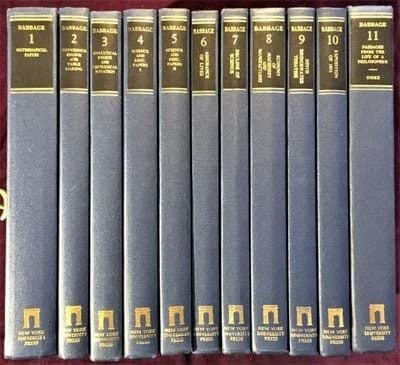
On the Economy of Machinery and ManufacturesBabbage, Charles
ReligionComparative
On the Economy of Machinery and Manufactures
Babbage, Charles
Machinery; Manufactures
212. We may trace the relative influence of the two causes
above referred to, in the prices of fine gold chains made at
Venice. The sizes of these chains are known by numbers, the
smallest having been (in 1828) No. 1, and the numbers 2, 3, 4,
etc., progressively increasing in size. The following table shews
the numbers and the prices of those made at that time.(1*) The
first column gives the number by which the chain is known; the
second expresses the weight in grains of one inch in length of
each chain; the third column the number of links in the same
length; and the last expresses the price, in francs worth
tenpence each, of a Venetian braccio, or about two English feet
of each chain.
Venetian gold chains
Price of a Venetian
Braccio, equal to
Weight of Number of links two feet 1/8 inch
No. one inch, in grains in one inch English
0.44 98 to 100 60 francs
1.56 92 40
1 1/2.77 88 26
2.99 84 20
3 1.46 72 20
4 1.61 64 21
5 2.09 64 23
6 2.61 60 24
7 3.36 56 27
8 3.65 56 29
9 3.72 56 32
10 5.35 50 34
24 9.71 32 60
Amongst these chains, that numbered 0 and that numbered 24
are exactly of the same price, although the quantity of gold in
the latter is twenty-two times as much as in the former. The
difficulty of making the smallest chain is so great, that the
women who make it cannot work above two hours at a time. As we
advance from the smaller chain, the proportionate value of the
work to the worth of the material becomes less and less, until at
the numbers 2 and 3, these two elements of cost balance each
other: after which, the difficulty of the work decreases, and the
value of the material increases.
213. The quantity of labour expended on these chains is,
however, incomparably less than that which is applied in some of
the manufactures of iron. In the case of the smallest Venetian
chain the value of the labour is not above thirty times that of
the gold. The pendulum spring of a watch, which governs the
vibrations of the balance, costs at the retail price two pence,
and weighs fifteen one-hundredths of a grain, whilst the retail
price of a pound of the best iron, the raw material out of which
fifty thousand such springs are made, is exactly the same sum of
two pence.
214. The comparative price of labour and of raw material
entering into the manufactures of France, has been ascertained
with so much care, in a memoir of M. A. M. Heron de Villefosse,
Recherches statistiques, sur les Metaux de France.(2*) that we
shall give an abstract of his results reduced to English
measures. The facts respecting the metals relate to the year
1825.
In France the quantity of raw material which can be purchased
for L1, when manufactured into
Silk goods is worth L2.37
Broad cloth and woollens 2.15
Hemp and cables 3.94
Linen comprising thread laces 5.00
Cotton goods 2.44
The price of pig-lead was L1 1s. per cwt; and lead of the value
of L1 sterling, became worth, when manufactured into
Public-domain text, read in full here on John Shaqi.
Reviews
Reviews
No reviews yet
Be the first to share your thoughts on this work.
Elsewhere in the archive
Join the Discussion
Join the discussion
Sign in to leave a comment or review.
Sign InorCreate an account