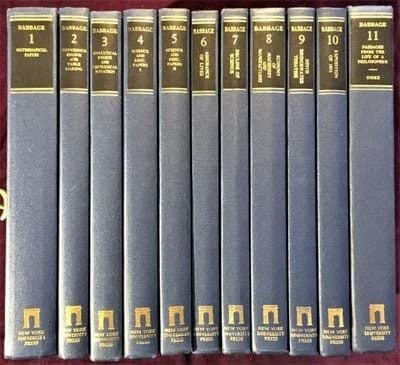
On the Economy of Machinery and ManufacturesBabbage, Charles
ReligionComparative
On the Economy of Machinery and Manufactures
Babbage, Charles
Machinery; Manufactures
1. Wire-drawing. (a) The brass wire used for making pins is
purchased by the manufacturer in coils of about twenty-two inches
in diameter, each weighing about thirty-six pounds. (b) The coils
are wound off into smaller ones of about six inches in diameter,
and between one and two pounds' weight. (c) The diameter of this
wire is now reduced, by drawing it repeatedly through holes in
steel plates, until it becomes of the size required for the sort
of pins intended to be made. During this process the wire is
hardened, and to prevent its breaking, it must be annealed two or
three times, according to the diminution of diameter required.
(d) The coils are then soaked in sulphuric acid, largely diluted
with water, in order to clean them, and are then beaten on stone,
for the purpose of removing any oxidated coating which may adhere
to them. These operations are usually performed by men, who draw
and clean from thirty to thirty-six pounds of wire a day. They
are paid at the rate of five farthings per pound, and generally
earn about 3s. 6d. per day.
M. Perronnet made some experiments on the extension the wire
undergoes in passing through each hole: he took a piece of thick
Swedish brass wire, and found
Feet Inches
Its length to be before drawing 3 8
After passing the first hole 5 5
second hole 7 2
third hole 7 8
It was now annealed, and the length became
After passing the fourth hole 10 8
fifth hole 13 1
sixth hole 16 8
And finally, after passing through six other holes 144 0
The holes through which the wire was drawn were not, in this
experiment, of regularly decreasing diameter: it is extremely
difficult to make such holes, and still more to preserve them in
their original dimensions.
229. 2. Straightening the wire. The coil of wire now passes
into the hands of a woman, assisted by a boy or girl. A few
nails, or iron pins, not quite in a line, are fixed into one end
of a wooden table about twenty feet in length; the end of the
wire is passed alternately between these nails, and is then
pulled to the other end of the table. The object of this process
is to straighten the wire, which had acquired a considerable
curvature in the small coils in which it had been wound. The
length thus straightened is cut off, and the remainder of the
coil is drawn into similar lengths. About seven nails or pins are
employed in straightening the wire, and their adjustment is a
matter of some nicety. It seems, that by passing the wire between
the first three nails or pins, a bend is produced in an opposite
direction to that which the wire had in the coil; this bend, by
passing the next two nails, is reduced to another less curved in
the first direction, and so on till the curve of the wire may at
last be confounded with a straight line.
Public-domain text, read in full here on John Shaqi.
Reviews
Reviews
No reviews yet
Be the first to share your thoughts on this work.
Elsewhere in the archive
Join the Discussion
Join the discussion
Sign in to leave a comment or review.
Sign InorCreate an account