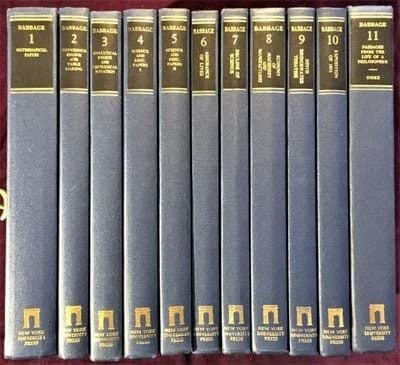
On the Economy of Machinery and ManufacturesBabbage, Charles
ReligionComparative
On the Economy of Machinery and Manufactures
Babbage, Charles
Machinery; Manufactures
254. One of the first advantages which suggests itself as
likely to arise from a correct analysis of the expense of the
several processes of any manufacture, is the indication which it
would furnish of the course in which improvement should be
directed. If a method could be contrived of diminishing by one
fourth the time required for fixing on the heads of pins, the
expense of making them would be reduced about thirteen per cent;
whilst a reduction of one half the time employed in spinning the
coil of wire out of which the heads are cut, would scarcely make
any sensible difference in the cost of manufacturing of the
whole article. It is therefore obvious, that the attention would
be much more advantageously directed to shortening the former
than the latter process.
255. The expense of manufacturing, in a country where
machinery is of the rudest kind, and manual labour is very cheap,
is curiously exhibited in the price of cotton cloth in the island
of Java. The cotton, in the seed, is sold by the picul, which is
a weight of about 133 lbs. Not above one fourth or one fifth of
this weight, however, is cotton: the natives, by means of rude
wooden rollers, can only separate about 1 1/4 lb. of cotton from
the seed by one day's labour. A picul of cleansed cotton,
therefore, is worth between four and five times the cost of the
impure article; and the prices of the same substance, in its
different stages of manufacture, are--for one picul:
Dollars Cotton in the seed 2 to 3
Clean cotton 10 to 11
Cotton thread 24
Cotton thread dyed blue 35
Good ordinary cotton cloth 50
Thus it appears that the expense of spinning in Java is 117
per cent on the value of the raw material; the expense of dying
thread blue is 45 per cent on its value; and that of weaving
cotton thread into cloth 117 per cent on its value. The expense
of spinning cotton into a fine thread is, in England, about 33
per cent. (1*)
256. As an example of the cost of the different processes of
a manufacture, perhaps an analytical statement of the expense of
the volume now in the reader's hands may not be uninteresting;
more especially as it will afford an insight into the nature and
extent of the taxes upon literature. It is found economical to
print it upon paper of a very large size, so that although
thirty-two pages, instead of sixteen, are really contained in
each sheet, this work is still called octavo.
L s. d.
To printer, for composing (per sheet of 32 pages) L3 1s. 10 1/2
sheets 32 0 6 [This relates to the ordinary size of the type used
in the volume.]
To printer for composing small type, as in extracts and 2 0 3
contents, extra per sheet, 3s. 10d.
Public-domain text, read in full here on John Shaqi.
Reviews
Reviews
No reviews yet
Be the first to share your thoughts on this work.
Elsewhere in the archive
Join the Discussion
Join the discussion
Sign in to leave a comment or review.
Sign InorCreate an account