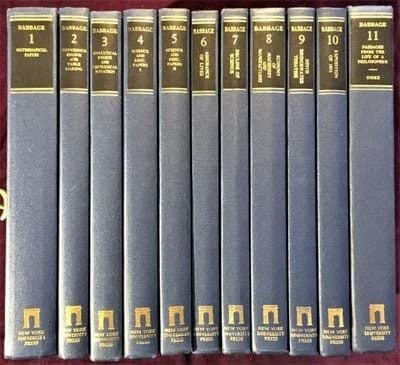
On the Economy of Machinery and ManufacturesBabbage, Charles
ReligionComparative
On the Economy of Machinery and Manufactures
Babbage, Charles
Machinery; Manufactures
The same reasoning extends to every manufacture which is
conducted upon the principle of the division of labour, and we
arrive at this general conclusion: When the number of processes
into which it is most advantageous to divide it, and the number
of individuals to be employed in it, are ascertained, then all
factories which do not employ a direct multiple of this latter
number, will produce the article at a greater cost. This
principle ought always to be kept in view in great
establishments, although it is quite impossible, even with the
best division of the labour, to attend to it rigidly in practice.
The proportionate number of the persons who possess the greatest
skill, is of course to be first attended to. That exact ratio
which is more profitable for a factory employing a hundred
workmen, may not be quite the best where there are five hundred;
and the arrangements of both may probably admit of variations,
without materially increasing the cost of their produce. But it
is quite certain that no individual, nor in the case of
pin-making could any five individuals, ever hope to compete with
an extensive establishment. Hence arises one cause of the great
size of manufacturing establishments, which have increased with
the progress of civilization. Other circumstances, however,
contribute to the same end, and arise also from the same cause--
the division of labour.
264. The material out of which the manufactured article is
produced, must, in the several stages of its progress, be
conveyed from one operator to the next in succession: this can be
done at least expense when they are all working in the same
establishment. If the weight of the material is considerable,
this reason acts with additional force; but even where it is
light, the danger arising from frequent removal may render it
desirable to have all the processes carried on in the same
building. In the cutting and polishing of glass this is the case;
whilst in the art of needle-making several of the processes are
carried on in the cottages of the workmen. It is, however, clear
that the latter plan, which is attended with some advantages to
the family of the workmen, can be adopted only where there exists
a sure and quick method of knowing that the work has been well
done, and that the whole of the materials given out have been
really employed.
265. The inducement to contrive machines for any process of
manufacture increases with the demand for the article; and the
introduction of machinery, on the other hand, tends to increase
the quantity produced and to lead to the establishment of large
factories. An illustration of these principles may be found in
the history of the manufacture of patent net.
Public-domain text, read in full here on John Shaqi.
Reviews
Reviews
No reviews yet
Be the first to share your thoughts on this work.
Elsewhere in the archive
Join the Discussion
Join the discussion
Sign in to leave a comment or review.
Sign InorCreate an account