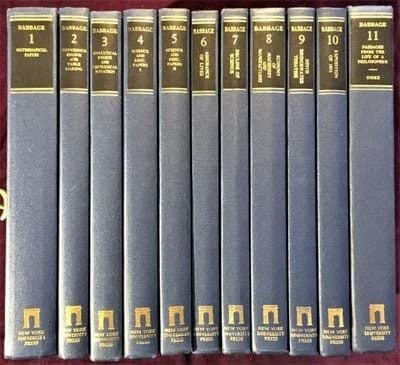
On the Economy of Machinery and ManufacturesBabbage, Charles
ReligionComparative
On the Economy of Machinery and Manufactures
Babbage, Charles
Machinery; Manufactures
296. Supposing, on the occurrence of a glut, that new and
cheaper modes of producing are not discovered, and that the
production continues to exceed the demand, then it is apparent
that too much capital is employed in the trade; and after a time,
the diminished rate of profit will drive some of the
manufacturers to other occupations. What particular individuals
will leave it must depend on a variety of circumstances. Superior
industry and attention will enable some factories to make a
profit rather beyond the rest; superior capital in others will
enable them, without these advantages, to support competition
longer, even at a loss, with the hope of driving the smaller
capitalists out of the market, and then reimbursing themselves by
an advanced price. It is, however, better for all parties, that
this contest should not last long; and it is important, that no
artificial restraint should interfere to prevent it. An instance
of such restriction, and of its injurious effect, occurs at the
port of Newcastle, where a particular Act of Parliament requires
that every ship shall be loaded in its turn. The Committee of the
House of Commons, in their Report on the Coal Trade, state that,
'Under the regulations contained in this Act, if more ships
enter into the trade than can be profitablv employed in it, the
loss produced by detention in port, and waiting for a cargo.
which must consequently take place, instead of falling, as it
naturally would, upon particular ships, and forcing them from the
trade, is now divided evenly amongst them; and the loss thus
created is shared by the whole number.' Report, p. 6.
297. It is not pretended, in this short view, to trace out all
the effects or remedies of over-manufacturing; the subject is
difficult, and, unlike some of the questions already treated,
requires a combined view of the relative influence of many
concurring causes.
NOTES:
1. The average price per ton of pig iron, bar iron, and coal,
together with the price paid for labour at the works, for a long
series of years, would be very valuable, and I shall feel much
indebted to anyone who will favour me with it for any, even
short, period.
2. The accurate proportions are, by measure, oxygen 21, azote 79.
3. A similar reasoning may be applied to lamps. An Argand burner,
whether used for consuming oil or gas, admits almost an unlimited
quantity of air. It would deserve enquiry, whether a smaller
quantity might not produce greater light; and, possibly, a
different supply furnish more heat with the same expenditure of
fuel.
4. Deutoxide of hydrogen, the oxygenated water of Thenard.
Chapter 25
Enquiries Previous to Commencing any Manufactory
Public-domain text, read in full here on John Shaqi.
Reviews
Reviews
No reviews yet
Be the first to share your thoughts on this work.
Elsewhere in the archive
Join the Discussion
Join the discussion
Sign in to leave a comment or review.
Sign InorCreate an account