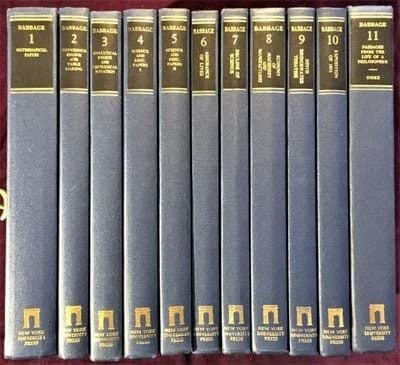
On the Economy of Machinery and ManufacturesBabbage, Charles
ReligionComparative
On the Economy of Machinery and Manufactures
Babbage, Charles
Machinery; Manufactures
Question. You can now make dolls' eyes?
Answer. I can. As it was eighteen years ago that I received the
order I have mentioned, and feeling doubtful of my own
recollection, though very strong, and suspecting that it could
[not] have been to the amount stated, I last night took the
present very reduced price of that article (less than half now of
what it was then), and calculating that every child in this
country not using a doll till two years old, and throwing it
aside at seven, and having a new one annually, I satisfied myself
that the eyes alone would produce a circulation of a great many
thousand pounds. I mention this merely to shew the importance of
trifles; and to assign one reason, amongst many, for my
conviction that nothing but personal communication can enable
our manufactures to be transplanted.
301. In many instances it is exceedingly difficult to
estimate beforehand the sale of an article, or the effects of a
machine; a case, however, occurred during a recent enquiry, which
although not quite appropriate as an illustration of probable
demand, is highly instructive as to the mode of conducting
investigations of this nature. A committee of the House of
Commons was appointed to enquire into the tolls proper to be
placed on steam-carriages; a question, apparently, of difficult
solution, and upon which widely different opinions had been
formed, if we may judge by the very different rate of tolls
imposed upon such carriages by different 'turnpike trusts'. The
principles on which the committee conducted the enquiry were,
that 'The only ground on which a fair claim to toll can be made
on any public road, is to raise a fund, which, with the strictest
economy, shall be just sufficient--first, to repay the expense
of its original formation; secondly, to maintain it in good and
sufficient repair.' They first endeavoured to ascertain, from
competent persons, the effect of the atmosphere alone in
deteriorating a well-constructed road. The next step was, to
determine the proportion in which the road was injured, by the
effect of the horses' feet compared with that of the wheels. Mr
Macneill, the superintendent, under Mr Telford, of the Holyhead
roads, was examined, and proposed to estimate the relative
injury, from the comparative quantities of iron worn off from the
shoes of the horses, and from the tire of the wheels. From the
data he possessed, respecting the consumption of iron for the
tire of the wheels, and for the shoes of the horses, of one of
the Birmingham day-coaches, he estimated the wear and tear of
roads, arising from the feet of the horses, to be three times as
great as that arising from the wheels. Supposing repairs
amounting to a hundred pounds to be required on a road travelled
over by a fast coach at the rate of ten miles an hour, and the
same amount of injury to occur on another road, used only by
waggons, moving at the rate of three miles an hour, Mr Macneill
divides the injuries in the following proportions:
Public-domain text, read in full here on John Shaqi.
Reviews
Reviews
No reviews yet
Be the first to share your thoughts on this work.
Elsewhere in the archive
Join the Discussion
Join the discussion
Sign in to leave a comment or review.
Sign InorCreate an account