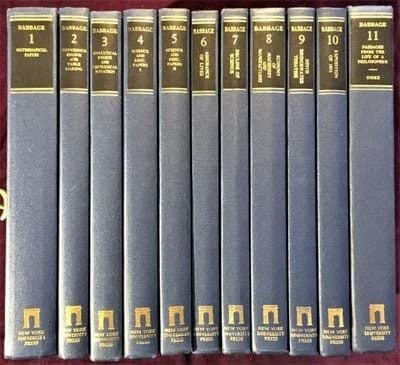
On the Economy of Machinery and ManufacturesBabbage, Charles
ReligionComparative
On the Economy of Machinery and Manufactures
Babbage, Charles
Machinery; Manufactures
individual partakes of that advantage exactly in proportion to
the extent to which he contributes towards it; nor do I perceive
that the resulting advantage is as immediate as it might become
under a different system.
306. It would be of great importance, if, in every large
establishment the mode of payment could be so arranged, that
every person employed should derive advantage from the success of
the whole; and that the profits of each individual should
advance, as the factory itself produced profit, without the
necessity of making any change in the wages. This is by no means
easy to effect, particularly amongst that class whose daily
labour procures for them their daily food. The system which has
long been pursued in working the Cornish mines, although not
exactly fulfilling these conditions, yet possesses advantages
which make it worthy of attention, as having nearly approached
towards them, and as tending to render fully effective the
faculties of all who are engaged in it. I am the more strongly
induced to place before the reader a short sketch of this system,
because its similarity to that which I shall afterwards recommend
for trial, will perhaps remove some objections to the latter, and
may also furnish some valuable hints for conducting any
experiment which might be undertaken.
307. In the mines of Cornwall, almost the whole of the
operations, both above and below ground, are contracted for. The
manner of making the contract is nearly as follows. At the end of
every two months, the work which it is proposed to carry on
during the next period is marked out. It is of three kinds. 1.
Tutwork, which consists in sinking shafts, driving levels, and
making excavations: this is paid for by the fathom in depth, or
in length, or by the cubic fathom. 2. Tribute, which is payment
for raising and dressing the ore, by means of a certain part of
its value when rendered merchantable. It is this mode of payment
which produces such admirable effects. The miners, who are to be
paid in proportion to the richness of the vein, and the quantity
of metal extracted from it, naturally become quicksighted in the
discovery of ore, and in estimating its value; and it is their
interest to avail themselves of every improvement that can bring
it more cheaply to market. 3. Dressing. The 'Tributors', who dig
and dress the ore, can seldom afford to dress the coarser parts
of what they raise, at their contract price; this portion,
therefore, is again let out to other persons, who agree to dress
it at an advanced price.
Public-domain text, read in full here on John Shaqi.
Reviews
Reviews
No reviews yet
Be the first to share your thoughts on this work.
Elsewhere in the archive
Join the Discussion
Join the discussion
Sign in to leave a comment or review.
Sign InorCreate an account