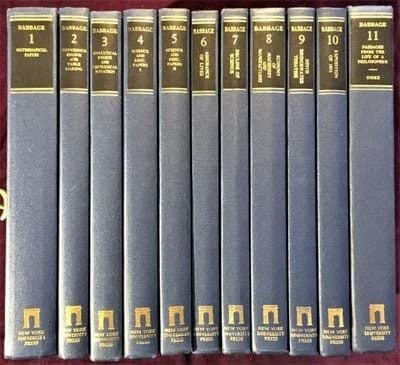
On the Economy of Machinery and ManufacturesBabbage, Charles
ReligionComparative
On the Economy of Machinery and Manufactures
Babbage, Charles
Machinery; Manufactures
{I was wrong in this conjecture; all booksellers are not so
shrewd as I had imagined, for some did refuse to sell this
volume; consequently others sold a larger number of copies.
In the preface to the second edition, at the commencement of
this volume, the reader will find some further observation on the
effect of the booksellers' combination.}
Chapter 32
On the Effect of Machinery in Reducing the Demand for Labour
404. One of the objections most frequently urged against
machinery is, that it has a tendency to supersede much of the
hand labour which was previously employed; and in fact unless a
machine diminished the labour necessary to make an article, it
could never come into use. But if it have that effect, its owner,
in order to extend the sale of his produce, will be obliged to
undersell his competitors; this will induce them also to
introduce the new machine, and the effect of this competition
will soon cause the article to fall, until the profits on
capital, under the new system, shall be reduced to the same rate
as under the old. Although, therefore, the use of machinery has
at first a tendency to throw labour out of employment, yet the
increased demand consequent upon the reduced price, almost
immediately absorbs a considerable portion of that labour, and
perhaps, in some cases, the whole of what would otherwise have
been displaced.
That the effect of a new machine is to diminish the labour
required for the production of the same quantity of manufactured
commodities may be clearly perceived, by imagining a society,
in which occupations are not divided, each man himself manufacturing
all the articles he consumes. Supposing each individual to labour
during ten hours daily, one of which is devoted to making shoes,
it is evident that if any tool or machine be introduced, by the
use of which his shoes can be made in half the usual time, then
each member of the community will enjoy the same comforts as
before by only nine and one-half hours' labour.
405. If, therefore, we wish to prove that the total quantity
of labour is not diminished by the introduction of machines, we must
have recourse to some other principle of our nature. But the same
motive which urges a man to activity will become additionally
powerful, when he finds his comforts procured with diminished
labour; and in such circumstances, it is probable, that many
would employ the time thus redeemed in contriving new tools for
other branches of their occupations. He who has habitually worked
ten hours a day, will employ the half hour saved by the new
machine in gratifying some other want; and as each new machine
adds to these gratifications, new luxuries will open to his view,
which continued enjoyment will as surely render necessary to his
happiness.
Public-domain text, read in full here on John Shaqi.
Reviews
Reviews
No reviews yet
Be the first to share your thoughts on this work.
Elsewhere in the archive
Join the Discussion
Join the discussion
Sign in to leave a comment or review.
Sign InorCreate an account