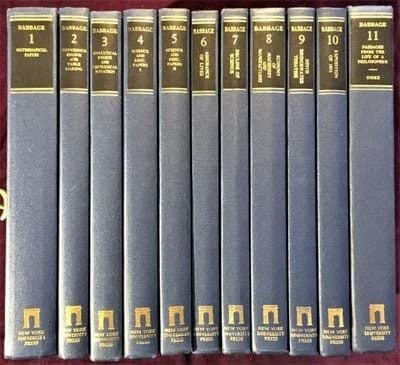
On the Economy of Machinery and ManufacturesBabbage, Charles
ReligionComparative
On the Economy of Machinery and Manufactures
Babbage, Charles
Machinery; Manufactures
416. The effects of regulations of excise upon our home
manufactures are often productive of great inconvenience; and
check, materially, the natural progress of improvement. It is
frequently necessary, for the purposes of revenue, to oblige
manufacturers to take out a license, and to compel them to work
according to certain rules, and to make certain stated quantities
at each operation. When these quantities are large, as in general
they are, they deter manufacturers from making experiments, and
thus impede improvements both in the mode of conducting the
processes and in the introduction of new materials. Difficulties
of this nature have occurred in experimenting upon glass for
optical purposes; but in this case, permission has been obtained
by fit persons to make experiments, without the interference of
the excise. It ought, however, to be remembered, that such
permission, if frequently or indiscriminately granted, might be
abused: the greatest protection against such an abuse will be
found, in bringing the force of public opinion to bear upon
scientific men and thus enabling the proper authorities, although
themselves but moderately conversant with science, to judge of
the propriety of the permission, from the public character of the
applicant.
417. From the evidence given, in 1808, before the Committee
of the House of Commons, On Distillation from Sugar and Molasses,
it appeared that, by a different mode of working from that
prescribed by the Excise, the spirits from a given weight of
corn, which then produced eighteen gallons, might easily have
been increased to twenty gallons. Nothing more is required for
this purpose, than to make what is called the wash weaker, the
consequence of which is, that fermentation goes on to a greater
extent. It was stated, however, that such a deviation would
render the collection of the duty liable to great difficulties;
and that it would not benefit the distiller much, since his price
was enhanced to the customer by any increase of expense in the
fabrication. Here then is a case in which a quantity, amounting
to one-ninth of the total produce, is actually lost to the
country. A similar effect arises in the coal trade, from the
effect of a duty, for, according to the evidence before the
House of Commons, it appears that a considerable quantity of the
very best coal is actually wasted. The extent of this waste is
very various in different mines; but in some cases it amounts to
one-third.
Public-domain text, read in full here on John Shaqi.
Reviews
Reviews
No reviews yet
Be the first to share your thoughts on this work.
Elsewhere in the archive
Join the Discussion
Join the discussion
Sign in to leave a comment or review.
Sign InorCreate an account