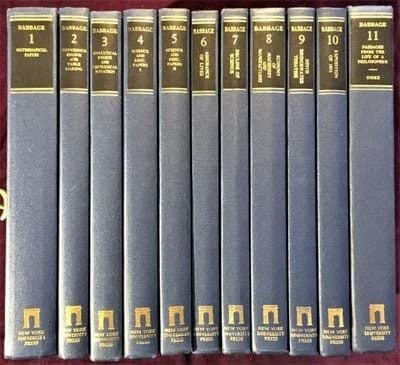
On the Economy of Machinery and ManufacturesBabbage, Charles
ReligionComparative
On the Economy of Machinery and Manufactures
Babbage, Charles
Machinery; Manufactures
104. Register printing. It is sometimes thought necessary to
print from a wooden block, or stereotype plate, the same pattern
reversed upon the opposite side of the paper. The effect of this,
which is technically called Register printing, is to make it
appear as if the ink had penetrated through the paper, and
rendered the pattern visible on the other side. If the subject
chosen contains many fine lines, it seems at first sight
extremely difficult to effect so exact a super position of the
two patterns, on opposite sides of the same piece of paper, that
it shall be impossible to detect the slightest deviation; yet the
process is extremely simple. The block which gives the impression
is always accurately brought down to the same place by means of a
hinge; this spot is covered by a piece of thin leather stretched
over it; the block is now inked, and being brought down to its
place, gives an impression of the pattern to the leather: it is
then turned back; and being inked a second time, the paper
intended to be printed is placed upon the leather, when the block
again descending, the upper surface of the paper is printed from
the block, and its undersurface takes up the impression from the
leather. It is evident that the perfection of this mode of
printing depends in a great measure on finding some soft
substance like leather, which will take as much ink as it ought
from the block, and which will give it up most completely to
paper. Impressions thus obtained are usually fainter on the lower
side; and in order in some measure to remedy this defect, rather
more ink is put on the block at the first than at the second
impression.
Of copying by casting
105. The art of casting, by pouring substances in a fluid
state into a mould which retains them until they become solid, is
essentially an art of copying; the form of the thing produced
depending entirely upon that of the pattern from which it was
formed.
Public-domain text, read in full here on John Shaqi.
Reviews
Reviews
No reviews yet
Be the first to share your thoughts on this work.
Elsewhere in the archive
Join the Discussion
Join the discussion
Sign in to leave a comment or review.
Sign InorCreate an account