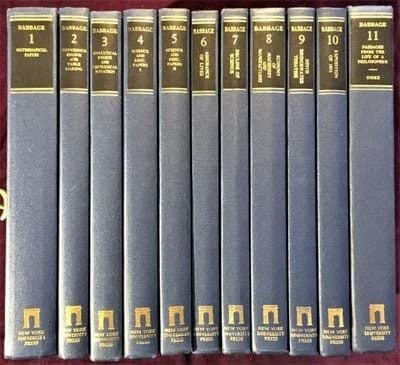
On the Economy of Machinery and ManufacturesBabbage, Charles
ReligionComparative
On the Economy of Machinery and Manufactures
Babbage, Charles
Machinery; Manufactures
106. Of casting iron and other metals.--Patterns of wood or
metal made from drawings are the originals from which the moulds
for casting are made: so that, in fact, the casting itself is a
copy of the mould; and the mould is a copy of the pattern. In
castings of iron and metals for the coarser purposes, and, if
they are afterwards to be worked even for the finer machines,
the exact resemblance amongst the things produced, which takes
place in many of the arts to which we have alluded, is not
effected in the first instance, nor is this necessary. As the
metals shrink in cooling, the pattern is made larger than the
intended copy; and in extricating it from the sand in which it is
moulded, some little difference will occur in the size of the
cavity which it leaves. In smaller works where accuracy is more
requisite, and where few or no after operations are to be
performed, a mould of metal is employed which has been formed
with considerable care. Thus, in casting bullets, which ought to
be perfectly spherical and smooth, an iron instrument is used, in
which a cavity has been cut and carefully ground; and, in order
to obviate the contraction in cooling, a jet is left which may
supply the deficiency of metal arising from that cause, and which
is afterwards cut off. The leaden toys for children are cast in
brass moulds which open, and in which have been graved or
chiselled the figures intended to be produced.
107. A very beautiful mode of representing small branches of
the most delicate vegetable productions in bronze has been
employed by Mr Chantrey. A small strip of a fir-tree, a branch of
holly, a curled leaf of broccoli, or any other vegetable
production, is suspended by one end in a small cylinder of paper
which is placed for support within a similarly formed tin case.
The finest river silt, carefully separated from all the coarser
particles, and mixed with water, so as to have the consistency of
cream, is poured into the paper cylinder by small portions at a
time, carefully shaking the plant a little after each addition,
in order that its leaves may be covered, and that no bubbles of
air may be left. The plant and its mould are now allowed to dry,
and the yielding nature of the paper allows the loamy coating to
shrink from the outside. When this is dry it is surrounded by a
coarser substance; and, finally, we have the twig with all its
leaves embedded in a perfect mould. This mould is carefully
dried, and then gradually heated to a red heat. At the ends of
some of the leaves or shoots, wires have been left to afford
airholes by their removal, and in this state of strong ignition a
stream of air is directed into the hole formed by the end of the
branch. The consequence is, that the wood and leaves which had
been turned into charcoal by the fire, are now converted into
carbonic acid by the current of air; and, after some time, the
whole of the solid matter of which the plant consisted is
Public-domain text, read in full here on John Shaqi.
Reviews
Reviews
No reviews yet
Be the first to share your thoughts on this work.
Elsewhere in the archive
Join the Discussion
Join the discussion
Sign in to leave a comment or review.
Sign InorCreate an account