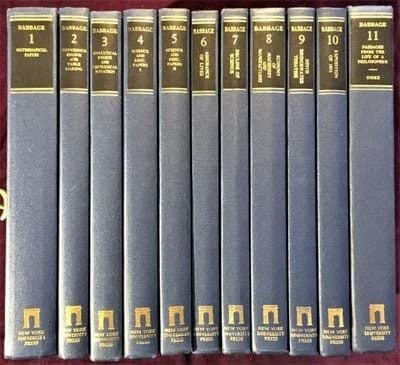
On the Economy of Machinery and ManufacturesBabbage, Charles
ReligionComparative
On the Economy of Machinery and Manufactures
Babbage, Charles
Machinery; Manufactures
115. Glass seals. The process of engraving upon gems requires
considerable time and skill. The seals thus produced can
therefore never become common. Imitations, however, have been
made of various degrees of resemblance. The colour which is given
to glass is, perhaps, the most successful part of the imitation.
A small cylindrical rod of coloured glass is heated in the flame
of a blowpipe, until the extremity becomes soft. The operator
then pinches it between the ends of a pair of nippers, which are
formed of brass, and on one side of which the device intended for
the seal has been carved in relief. When the mould has been well
finished and care is taken in heating the glass properly, the
seals thus produced are not bad imitations; and by this system of
copying they are so multiplied, that the more ordinary kinds are
sold at Birmingham for three pence a dozen.
116. Square glass bottles. The round forms which are usually
given to vessels of glass are readily produced by the expansion
of the air with which they are blown. It is, however, necessary
in many cases to make bottles of a square form, and each capable
of holding exactly the same quantity of fluid. It is also
frequently desirable to have imprinted on them the name of the
maker of the medicine or other liquid they are destined to
contain. A mould of iron, or of copper, is provided of the
intended size, on the inside of which are engraved the names
required. This mould, which is used in a hot state, opens into
two parts, to allow the insertion of the round, unfinished
bottle, which is placed in it in a very soft state before it is
removed from the end of the iron tube with which it was blown.
The mould is now closed, and the glass is forced against its
sides, by blowing strongly into the bottle.
117. Wooden snuff boxes. Snuff boxes ornamented with devices,
in imitation of carved work or of rose engine turning, are sold
at a price which proves that they are only imitations. The wood,
or horn, out of which they are formed, is softened by long
boiling in water, and whilst in this state it is forced into
moulds of iron, or steel, on which are cut the requisite
patterns, where it remains exposed to great pressure until it is
dry.
118. Horn knife handles and umbrella handles. The property
which horn possesses of becoming soft by the action of water and
of heat, fits it for many useful purposes. It is pressed into
moulds, and becomes embossed with figures in relief, adapted to
the objects to which it is to be applied. If curved, it may be
straightened; or if straight, it may be bent into any forms which
ornament or utility may require; and by the use of the mould
these forms may be multiplied in endless variety. The commoner
sorts of knives, the crooked handles for umbrellas, and a
multitude of other articles to which horn is applied, attest the
cheapness which the art of copying gives to the things formed of
this material.
Public-domain text, read in full here on John Shaqi.
Reviews
Reviews
No reviews yet
Be the first to share your thoughts on this work.
Elsewhere in the archive
Join the Discussion
Join the discussion
Sign in to leave a comment or review.
Sign InorCreate an account