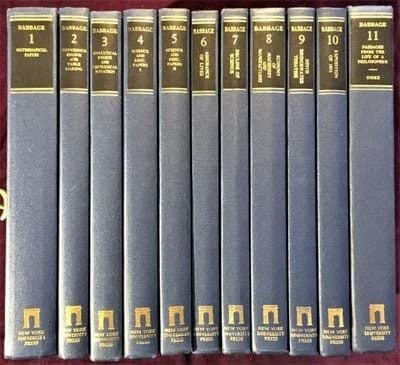
On the Economy of Machinery and ManufacturesBabbage, Charles
ReligionComparative
On the Economy of Machinery and Manufactures
Babbage, Charles
Machinery; Manufactures
119. Moulding tortoise-shell. The same principle is applied
to things formed out of the shell of the turtle, or the land
tortoise. From the greatly superior price of the raw material,
this principle of copying is, however, more rarely employed upon
it; and the few carvings which are demanded, are usually
performed by hand.
120. Tobacco-pipe making. This simple art is almost entirely
one of copying. The moulds are formed of iron, in two parts, each
embracing one half of the stem; the line of junction of these
parts may generally be observed running lengthwise from one end
of the pipe to the other. The hole passing to the bowl is formed
by thrusting a long wire through the clay before it is enclosed
in the mould. Some of the moulds have figures, or names, sunk in
the inside, which give a corresponding figure in relief upon the
finished pipe.
121. Embossing upon calico. Calicoes of one colour, but
embossed all over with raised patterns, though not much worn in
this country, are in great demand in several foreign markets.
This appearance is produced by passing them between rollers, on
one of which is figured in intaglio the pattern to be transferred
to the calico. The substance of the cloth is pressed very
forcibly into the cavities thus formed, and retains its pattern
after considerable use. The watered appearance in the cover of
the volume in the reader's hands is produced in a similar manner.
A cylinder of gun-metal, on which the design of the watering is
previously cut, is pressed by screws against another cylinder,
formed out of pieces of brown paper which have been strongly
compressed together and accurately turned. The two cylinders are
made to revolve rapidly, the paper one being slightly damped,
and, after a few minutes, it takes an impression from the upper
or metal one. The glazed calico is now passed between the
rollers, its glossy surface being in contact with the metal
cylinder, which is kept hot by a heated iron enclosed within it.
Calicoes are sometimes watered by placing two pieces on each
other in such a position that the longitudinal threads of the one
are at right angles to those of the other, and compressing them
in this state between flat rollers. The threads of the one piece
produce indentations in those of the other, but they are not so
deep as when produced by the former method.
122. Embossing upon leather. This art of copying from
patterns previously engraved on steel rollers is in most respects
similar to the preceding. The leather is forced into the
cavities, and the parts which are not opposite to any cavity are
powerfully condensed between the rollers.
Public-domain text, read in full here on John Shaqi.
Reviews
Reviews
No reviews yet
Be the first to share your thoughts on this work.
Elsewhere in the archive
Join the Discussion
Join the discussion
Sign in to leave a comment or review.
Sign InorCreate an account