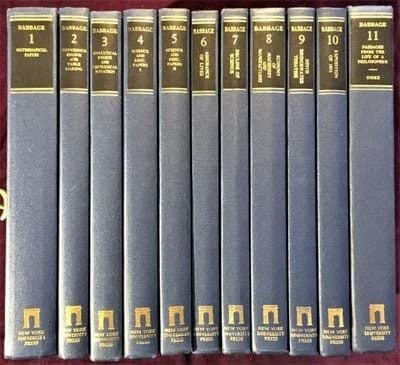
On the Economy of Machinery and ManufacturesBabbage, Charles
ReligionComparative
On the Economy of Machinery and Manufactures
Babbage, Charles
Machinery; Manufactures
143. Leaden pipes. Leaden pipes for the conveyance of water
were formerly made by casting; but it has been found that they
can be made both cheaper and better by drawing them through holes
in the manner last described. A cylinder of lead, of five or six
inches in diameter and about two feet long, is cast with a small
hole through its axis, and an iron triblet of about fifteen feet
in length is forced into the hole. It is then drawn through a
series of holes, until the lead is extended upon the triblet from
one end to the other, and is of the proper thickness in
proportion to the size of the pipe.
144. Iron rolling. When cylinders of iron of greater
thickness than wire are required, they are formed by passing
wrought iron between rollers, each of which has sunk in it a
semi-cylindrical groove; and as such rollers rarely touch
accurately, a longitudinal line will usually be observed in the
cylinders so manufactured. Bar iron is thus shaped into all the
various forms of round, square, half-round, oval, etc. in which
it occurs in commerce. A particular species of moulding is thus
made, which resembles, in its section, that part of the frame of
a window which separates two adjacent panes of glass. Being much
stronger than wood, it can be considerably reduced in thickness,
and consequently offers less obstruction to the light; it is much
used for skylights.
145. It is sometimes required that the iron thus produced
should not be of uniform thickness throughout. This is the case
in bars for railroads, where greater depth is required towards
the middle of the rail which is at the greatest distance from the
supports. This form is produced by cutting the groove in the
rollers deeper at those parts where additional strength is
required, so that the hollow which surrounds the roller would, if
it could be unwound, be a mould of the shape the iron is intended
to fit.
146. Vermicelli. The various forms into which this paste is
made are given by forcing it through holes in tin plate. It
passes through them, and appears on the other side in long
strings. The cook makes use of the same method in preparing
butter and ornamental pastry for the table, and the confectioner
in forming cylindrical lozenges of various composition.
Of copying with altered dimensions
147. Of the pentagraph. This mode of copying is chiefly used
for drawings or maps: the instrument is simple; and, although
usually employed in reducing, is capable of enlarging the size of
the copy. An automaton figure, exhibited in London a short time
since, which drew profiles of its visitors, was regulated by a
mechanism on this principle. A small aperture in the wall,
opposite the seat in which the person is placed whose profile is
taken, conceals a camera lucida, which is placed in an adjoining
apartment: and an assistant, by moving a point, connected by a
pentagraph with the hand of the automaton, over the outline of
the head, causes the figure to trace a corresponding profile.
Public-domain text, read in full here on John Shaqi.
Reviews
Reviews
No reviews yet
Be the first to share your thoughts on this work.
Elsewhere in the archive
Join the Discussion
Join the discussion
Sign in to leave a comment or review.
Sign InorCreate an account