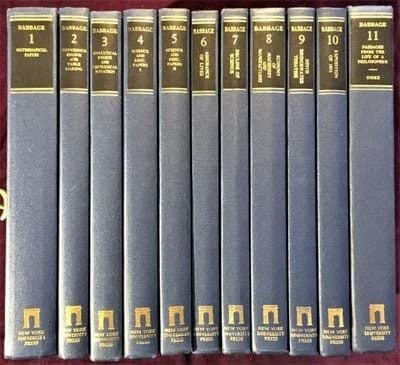
On the Economy of Machinery and ManufacturesBabbage, Charles
ReligionComparative
On the Economy of Machinery and Manufactures
Babbage, Charles
Machinery; Manufactures
151. Shoe-last making engine. An instrument not very unlike
in principle was proposed for the purpose of making shoe lasts. A
pattern last of a shoe for the right foot was placed in one part
of the apparatus, and when the machine was moved, two pieces of
wood, placed in another part which had been previously adjusted
by screws, were cut into lasts greater or less than the original,
as was desired; and although the pattern was for the right foot,
one of the lasts was for the left, an effect which was produced
by merely interposing a wheel which reversed the motion between
the two pieces of wood to be cut into lasts.
152. Engine for copying busts. Many years since, the late Mr
Watt amused himself with constructing an engine to produce copies
of busts or statues, either of the same size as the original, or
in a diminished proportion. The substances on which he operated
were various, and some of the results were shewn to his friends,
but the mechanism by which they were made has never been
described. More recently, Mr Hawkins, who, nearly at the same
time, had also contrived a similar machine, has placed it in the
hands of an artist, who has made copies in ivory from a variety
of busts. The art of multiplying in different sizes the figures
of the sculptor, aided by that of rendering their acquisition
cheap through the art of casting, promises to give additional
value to his productions, and to diffuse more widely the pleasure
arising from their possession.
153. Screw cutting. When this operation is performed in the
lathe by means of a screw upon the mandril, it is essentially an
art of copying, but it is only the number of threads in a given
length which is copied; the form of the thread, and length as
well as the diameter of the screw to be cut, are entirely
independent of those from which the copy is made. There is
another method of cutting screws in a lathe by means of one
pattern screw, which, being connected by wheels with the mandril,
guides the cutting point. In this process, unless the time of
revolution of the mandril is the same as that of the screw which
guides the cutting point, the number of threads in a given length
will be different. If the mandril move quicker than the cutting
point, the screw which is produced will be finer than the
original; if it move slower, the copy will be more coarse than
the original. The screw thus generated may be finer or coarser--
it may be larger or smaller in diameter--it may have the same or
a greater number of threads than that from which it is copied;
yet all the defects which exist in the original will be
accurately transmitted, under the modified circumstances, to
every individual generated from it.
Public-domain text, read in full here on John Shaqi.
Reviews
Reviews
No reviews yet
Be the first to share your thoughts on this work.
Elsewhere in the archive
Join the Discussion
Join the discussion
Sign in to leave a comment or review.
Sign InorCreate an account