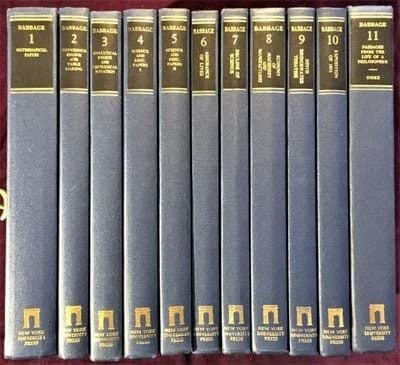
On the Economy of Machinery and ManufacturesBabbage, Charles
ReligionComparative
On the Economy of Machinery and Manufactures
Babbage, Charles
Machinery; Manufactures
1. They are copies, by printing, from stereotype plates.
2. These stereotype plates are copied, by the art of casting,
from moulds formed of plaster of Paris.
3. These moulds are themselves copied by casting the plaster
in a liquid state upon the moveable types set up by the
compositor.
[It is here that the union of the intellectual and the
mechanical departments takes place. The mysteries, however, of an
author's copying, form no part of our enquiry, although it may be
fairly remarked, that, in numerous instances, the mental far
eclipses the mechanical copyist.]
4. These moveable types, the obedient messengers of the most
opposite thoughts, the most conflicting theories, are themselves
copies by casting from moulds of copper called matrices.
5. The lower part of those matrices, bearing the impressions
of the letters or characters, are copies, by punching, from steel
punches on which the same characters exist in relief.
6. These steel punches are not themselves entirely exempted
from the great principle of art. Many of the cavities which exist
in them, such as those in the middle of the punches for the
letters a, b, d, e, g, etc., are produced from other steel
punches in which these parts are in relief.
We have thus traced through six successive stages of copying
the mechanical art of printing from stereotype plates: the
principle of copying contributing in this, as in every other
department of manufacture, to the uniformity and the cheapness of
the work produced.
NOTES:
1. The late Mr Lowry.
2. I posses a lithographic reprint of a page of a table, which
appears, from the from of the type, to have been several years
old.
3. The construction of the engraving becomes evident on examining
it with a lens of sufficient power to show the continuity of the
lines.
4. The Phalaena pardilla, which feeds on the Prunus padus.
5. Some of these weights and measures are calculated from a
statement in the Report of the Committee of the House of Commons
on Printed Cotton Goods; and the widths of the pieces there given
are presumed to be the real widths, not those by which they are
called in the retail shops.
Chapter 12
On the Method of Observing Manufactories
160. Having now reviewed the mechanical principles which
regulate the successful application of mechanical science to
great establishments for the production of manufactured goods, it
remains for us to suggest a few enquiries, and to offer a few
observations, to those whom an enlightened curiosity may lead to
examine the factories of this or of other countries.
Public-domain text, read in full here on John Shaqi.
Reviews
Reviews
No reviews yet
Be the first to share your thoughts on this work.
Elsewhere in the archive
Join the Discussion
Join the discussion
Sign in to leave a comment or review.
Sign InorCreate an account