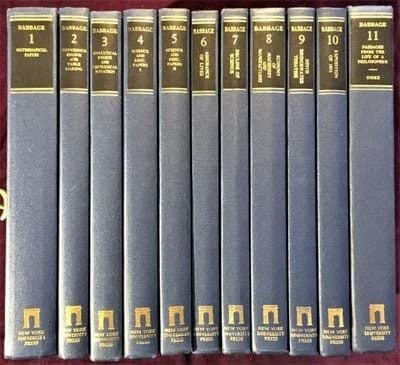
On the Economy of Machinery and ManufacturesBabbage, Charles
ReligionComparative
On the Economy of Machinery and Manufactures
Babbage, Charles
Machinery; Manufactures
174. It is difficult to form a satisfactory estimate of the
sums which daily pass through this operation: they fluctuate from
two millions to perhaps fifteen. About two millions and a half
may possibly be considered as something like an average,
requiring for its adjustment, perhaps, L200,000 in bank notes and
L20 in specie. By an agreement between the different bankers, all
checks which have the name of any firm written across them must
pass through the clearing house: consequently, if any such check
should be lost, the firm on which it is drawn would refuse to pay
it at the counter; a circumstance which adds greatly to the
convenience of commerce.
The advantage of this system is such, that two meetings a day
have been recently established--one at twelve, the other at
three o'clock; but the payment of balances takes place once only,
at five o'clock.
If all the private banks kept accounts with the Bank of
England, it would be possible to carry on the whole of these
transactions with a still smaller quantity of circulating medium.
175. In reflecting on the facility with which these vast
transactions are accomplished--supposing, for the sake of
argument, that they form only the fourth part of the daily
transactions of the whole community--it is impossible not to be
struck with the importance of interfering as little as possible
with their natural adjustment. Each payment indicates a transfer
of property made for the benefit of both parties; and if it were
possible, which it is not, to place, by legal or other means,
some impediment in the way which only amounted to one-eighth per
cent, such a species of friction would produce a useless
expenditure of nearly four millions annually: a circumstance
which is deserving the attention of those who doubt the good
policy of the expense incurred by using the precious metals for
one portion of the currency of the country.
176. One of the most obvious differences between a metallic
and a paper circulation is, that the coin can never, by any panic
or national danger, be reduced below the value of bullion in
other civilized countries; whilst a paper currency may, from the
action of such causes, totally lose its value. Both metallic and
paper money, it is true, may be depreciated, but with very
different effects.
Public-domain text, read in full here on John Shaqi.
Reviews
Reviews
No reviews yet
Be the first to share your thoughts on this work.
Elsewhere in the archive
Join the Discussion
Join the discussion
Sign in to leave a comment or review.
Sign InorCreate an account