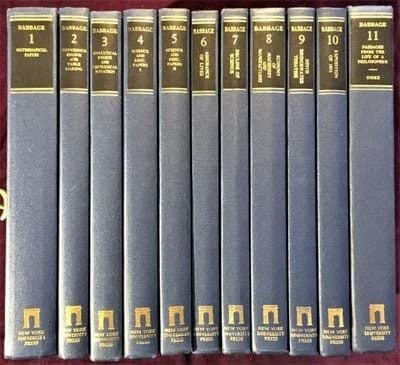
On the Economy of Machinery and ManufacturesBabbage, Charles
ReligionComparative
On the Economy of Machinery and Manufactures
Babbage, Charles
Machinery; Manufactures
191. The principle that price, at any moment, is dependent on
the relation of the supply to the demand, is true to the full
extent only when the whole supply is in the hands of a very large
number of small holders, and the demand is caused by the wants of
another set of persons, each of whom requires only a very small
quantity. And the reason appears to be, that it is only in such
circumstances that a uniform average can be struck between the
feelings, the passions, the prejudices, the opinions, and the
knowledge, of both parties. If the supply, or present stock in
hand, be entirely in the possession of one person, he will
naturally endeavour to put such a price upon it as shall produce
by its sale the greatest quantity of money; but he will be guided
in this estimate of the price at which he will sell, both by the
knowledge that increased price will cause a diminished
consumption, and by the desire to realize his profit before a new
supply shall reach the market from some other quarter. If,
however, the same stock is in the hands of several dealers, there
will be an immediate competition between them, arising partly
from their different views of the duration of the present state
of supply, and partly from their own peculiar circumstances with
respect to the employment of their capital.
192. The expense of ascertaining that the price charged is
that which is legally due is sometimes considerable. The
inconvenience which this verification produces in the case of
parcels sent by coaches is very great. The time lost in
recovering an overcharge generally amounts to so many times the
value of the sum recovered, that it is but rarely resorted to. It
seems worthy of consideration whether it would not be a
convenience to the public if government were to undertake the
general conveyance of parcels somewhat on the same system with
that on which the post is now conducted. The certainty of their
delivery, and the absence of all attempt at overcharge, would
render the prohibition of rival carriers unnecessary. Perhaps an
experiment might be made on this subject by enlarging the weight
allowed to be sent by the two-penny post, and by conveying works
in sheets by the general post.
This latter suggestion would be of great importance to
literature, and consequently to the circulation of knowledge. As
the post-office regulations stand at present, it constantly
happens that persons who have an extensive reputation for
science, receive by post, from foreign countries, works, or parts
of works, for which they are obliged to pay a most extravagant
rate of postage, or else refuse to take in some interesting
communication. In France and Germany, printed sheets of paper are
forwarded by post at a very moderate expense, and it is fit that
the science and literature of England should be equally favoured.
Public-domain text, read in full here on John Shaqi.
Reviews
Reviews
No reviews yet
Be the first to share your thoughts on this work.
Elsewhere in the archive
Join the Discussion
Join the discussion
Sign in to leave a comment or review.
Sign InorCreate an account