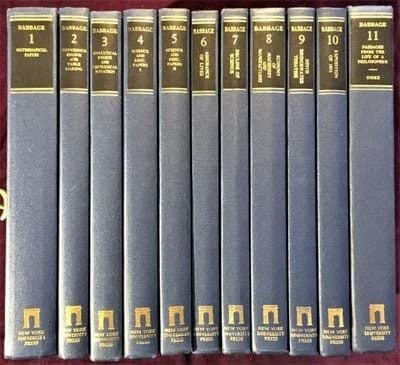
On the Economy of Machinery and ManufacturesBabbage, Charles
ReligionComparative
On the Economy of Machinery and Manufactures
Babbage, Charles
Machinery; Manufactures
199. There is a peculiarity in looking-glasses with reference
to the principle just mentioned. The most frequent occasion of
injury to them arises from accidental violence; and the
peculiarity is, that, unlike most other articles, when broken
they are still of some value. If a large mirror is accidentally
cracked, it is immediately cut into two or more smaller ones,
each of which may be perfect. If the degree of violence is so
great as to break it into many fragments, these smaller pieces
may be cut into squares for dressing-glasses; and if the
silvering is injured, it can either be resilvered or used as
plate-glass for glazing windows. The addition from our
manufactories to the stock of plate-glass in the country is
annually about two hundred and fifty thousand square feet. It
would be very difficult to estimate the quantity annually
destroyed or exported, but it is probably small; and the effect
of these continual additions is seen in the diminished price and
increased consumption of the article. Almost all the better order
of shop fronts are now glazed with it. If it were quite
indestructible, the price would continually diminish; and unless
an increased demand arose from new uses, or from a greater number
of customers, a single manufactory, unchecked by competition,
would ultimately be compelled to shut up, driven out of the
market by the permanance of its own productions.
200. The metals are in some degree permanent, although
several of them are employed in such forms that they are
ultimately lost.
Copper is a metal of which a great proportion returns to use:
a part of that employed in sheathing ships and covering houses is
lost from corrosion; but the rest is generally remelted. Some is
lost in small brass articles, and some is consumed in the
formation of salts, Roman vitriol (sulphate of copper), verdigris
(acetate of copper), and verditer.
Gold is wasted in gilding and in embroidering; but a portion
of this is recovered by burning the old articles. Some portion is
lost by the wear of gold, but, upon the whole, it possesses
considerable permanence.
Iron. A proportion of this metal is wasted by oxidation, in
small nails, in fine wire; by the wear of tools, and of the tire
of wheels, and by the formation of some dyes: but much, both of
cast- and of wrought-iron, returns to use.
Lead is wasted in great quantities. Some portion of that
which is used in pipes and in sheets for covering roofs returns
to the melting-pot; but large quantities are consumed in the form
of small shot, or sometimes in that of musket balls, litharge,
and red lead, for white and red paints, for glass-making, for
glazing pottery, and for sugar of lead (acetate of lead).
Silver is rather a permanent metal. Some portion is consumed
in the wear of coin, in that of silver plate, and a portion in
silvering and embroidering.
Tin. The chief waste of this metal arises from tinned iron;
some is lost in solder and in solutions for the dyers.
Chapter 17
Public-domain text, read in full here on John Shaqi.
Reviews
Reviews
No reviews yet
Be the first to share your thoughts on this work.
Elsewhere in the archive
Join the Discussion
Join the discussion
Sign in to leave a comment or review.
Sign InorCreate an account