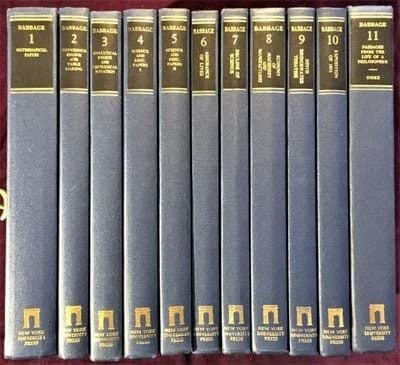
On the Economy of Machinery and ManufacturesBabbage, Charles
ReligionComparative
On the Economy of Machinery and Manufactures
Babbage, Charles
Machinery; Manufactures
203. I cannot omit availing myself of this opportunity of
calling the attention of the manufacturers, merchants, and
factors, in all our manufacturing and commercial towns, to the
great importance, both for their own interests, and for that of
the population to which their capital gives employment, of
collecting with care such averages from the actual sales
registered in their books. Nor, perhaps, would it be without its
use to suggest, that such averages would be still more valuable
if collected from as many different quarters as possible; that
the quantity of the goods from which they are deduced, together
with the greatest deviations from the mean, ought to be given;
and that if a small committee were to undertake the task, it
would give great additional weight to the information. Political
economists have been reproached with too small a use of facts,
and too large an employment of theory. If facts are wanting, let
it be remembered that the closet-philosopher is unfortunately too
little acquainted with the admirable arrangements of the factory,
and that no class of persons can supply so readily, and with so
little sacrifice of time, the data on which all the reasonings of
political economists are founded, as the merchant and
manufacturer; and, unquestionably, to no class are the deductions
to which they give rise so important. Nor let it be feared that
erroneous deductions may be made from such recorded facts: the
errors which arise from the absence of facts are far more
numerous and more durable than those which result from unsound
reasoning respecting true data.
204. The great diminution in price of the articles here
enumerated may have arisen from several causes: 1. The alteration
in the value of the currency. 2. The increased value of gold in
consequence of the increased demand for coin. The first of these
causes may have had some influence, and the second may have had a
very small effect upon the two first quotations of prices, but
none at all upon the two latter ones. 3. The diminished rate of
profit produced by capital however employed. This may be
estimated by the average price of three per cents at the periods
stated. 4. The diminished price of the raw materials out of which
these articles were manufactured. The raw material is principally
brass and iron, and the reduction upon it may, in some measure,
be estimated by the diminished price of iron and brass wire, in
the cost of which articles, the labour bears a less proportion
than it does in many of the others. 5. The smaller quantity of
raw material employed, and perhaps, in some instances, an
inferior, quality of workmanship. 6. The improved means by which
the same effect was produced by diminished labour.
205. In order to afford the means of estimating the influence
of these several causes, the following table is subjoined:
Public-domain text, read in full here on John Shaqi.
Reviews
Reviews
No reviews yet
Be the first to share your thoughts on this work.
Elsewhere in the archive
Join the Discussion
Join the discussion
Sign in to leave a comment or review.
Sign InorCreate an account