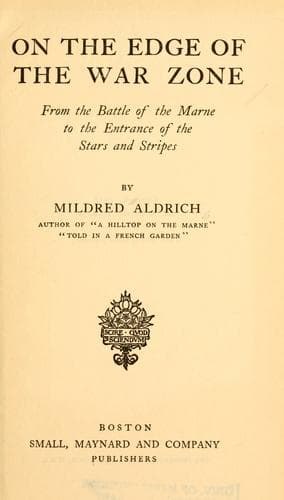
On the Edge of the War Zone: From the Battle of the Marne to the Entrance of the Stars and StripesAldrich, Mildred
History
On the Edge of the War Zone: From the Battle of the Marne to the Entrance of the Stars and Stripes
Aldrich, Mildred
World War, 1914-1918 -- Personal narratives
He looked really indignant, as he snapped: "That would be quite
unnatural. What do you suppose that Peppino and I are going to do
after a battle? Wait for the commissary department to find us? No,
madame, after a battle it will not be of my mother nor home, nor even
of you, that we will be thinking. We shall think of something to eat and
drink." Then he added, with a laugh, "Alas! We shan't have all these
nice things you have given us. They will have been eaten by
tomorrow."
I apologized, and said I'd know better another time, and he patted his
horse, as he backed away, and said to him: "Salute the lady,
Peppino, and tell her prettily that you had the honor of carrying Teddy
Roosevelt the day he went to the review." And the horse pawed and
bowed and neighed, and his rider wheeled him carefully as he saluted
and said: "Au revoir, I shall write, and, after the war, I shall give
myself the pleasure of seeing you," and he rode carefully out of the
gate--a very delicate operation, as only half of it was open. Laden
as the horse was, he just made it, and away he galloped down the
hill to Voisins, where the cavalry was assembling.
I stayed in the window a few minutes to wave a goodbye to the men
as they led each their three horses down the hill. Then I put on my
heaviest coat, a polo cap, all my furs and mittens, thrust my felt shoes
into my sabots, and with one hand in my muff, I took the big French
flag in the other and went through the snow down to the hedge to
watch the regiment pass, on the road to Esbly.
Even before I got out of the house the news came that the 118th
Regiment of infantry, the boys who retook Vaux in the great battle at
Verdun, had been marching in from Meaux, and were camped,
waiting to take up the billets the 23d Dragoons were vacating.
I stood in the snow for nearly half an hour, holding up the heavy flag,
which flapped bravely in the icy wind, and watching the long grey line
moving slowly along the road below. I could see half a mile of the line
--grey, steel-helmeted men, packed horses, grey wagons--winding
down the hill in the winter landscape, so different from the France I
had always known. Hardly a sound came back--no music, no colors--
the long, grey column moved in a silent, almost colorless world. I
shifted the heavy flag from one hand to the other as my fingers got
stiff, but, alas! I could not shift my feet. Long before the line had
passed I was forced to fasten the flag to a post in the hedge and
leave it to float by itself, and limp into the house. As a volunteer color-
bearer I was a failure. I had to let Amélie take off my shoes and rub
my feet, and I had hard work not to cry while she was doing it. I was
humiliated, especially as I remembered that the boys had a five
hours' march as their first étape, and a bivouac at the end of it.
Public-domain text, read in full here on John Shaqi.
Reviews
Reviews
No reviews yet
Be the first to share your thoughts on this work.
Elsewhere in the archive
Join the Discussion
Join the discussion
Sign in to leave a comment or review.
Sign InorCreate an account