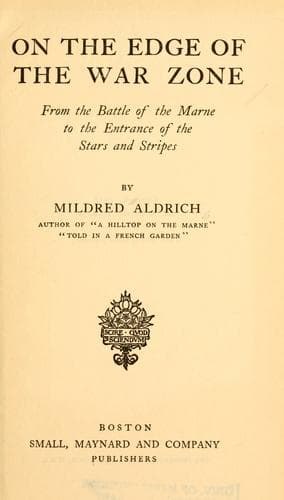
On the Edge of the War Zone: From the Battle of the Marne to the Entrance of the Stars and StripesAldrich, Mildred
History
On the Edge of the War Zone: From the Battle of the Marne to the Entrance of the Stars and Stripes
Aldrich, Mildred
World War, 1914-1918 -- Personal narratives
However, we are working tremendously for the coming offensive. And
I hope it will be the final one, for the Germans are beginning to show
signs of fatigue. News comes to us from the interior, from a reliable
source, which indicates that the situation on the other side of the
Rhine is anything but calm. More than ever now must we hang on, for
the victory is almost within our clutch.
Accept, madame, the assurance of my most respectful homage,
A------B------.
So you see, we were all too previous in expecting the offensive. The
cavalry is not yet really mounted for action. But we hope all the same.
The 118th is slowly settling down, but I'll tell you about that later.
XXXIV
February 10, 1917
Well, the 118th has settled down to what looks like a long
cantonnement. It is surely the liveliest as well as the biggest we ever
had here, and every little town and village is crowded between here
and Coulommier. Not only are there five thousand infantry billeted
along the hills and in the valleys, but there are big divisions of
artillery also. The little square in front of our railway station at
Couilly is full of grey cannon and ammunition wagons, and there
are military kitchens and all sorts of commissary wagons along
all the roadsides between here and Crécy-en-Brie, which is the
distributing headquarters for all sorts of material.
As the weather has been intolerably cold, though it is dry and often
sunny, the soldiers are billeted in big groups of fifty or sixty in a room
or grange, where they sleep in straw, rolled in their blankets, packed
like sardines to keep warm.
They came in nearly frozen, but they thawed out quickly, and now
they don't mind the weather at all.
Hardly had they got thawed out when an epidemic of mumps broke
out. They made quick work of evacuating those who had it, and stop
its spreading, to the regret, I am afraid, of a good many of the boys.
One of them said to me the day after the mumpy ones were taken
over to Meaux: "Lucky fellows. I wish I had the mumps. After Verdun
it must be jolly to be in the hospital with nothing more dangerous than
mumps, and a nice, pretty girl, in a white cap, to pet you. I can't think
of a handsomer way to spend a repos than that."
When I tell you that these soldiers say, "Men who have not been at
Verdun have not seen the war yet," and then add that the life of the
118th here looks like a long picnic, and that they make play of their
work, play of their grenade practice, which they vary with football, play
of their twenty miles hikes, I give you leave to laugh at my way of
seeing the war, and I'll even laugh with you.
Public-domain text, read in full here on John Shaqi.
Reviews
Reviews
No reviews yet
Be the first to share your thoughts on this work.
Elsewhere in the archive
Join the Discussion
Join the discussion
Sign in to leave a comment or review.
Sign InorCreate an account