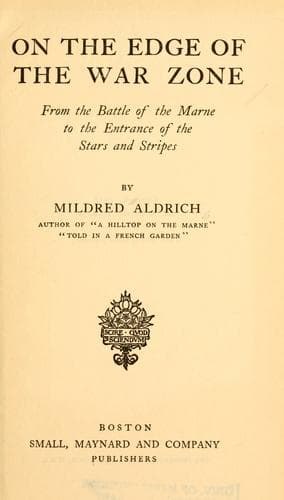
On the Edge of the War Zone: From the Battle of the Marne to the Entrance of the Stars and StripesAldrich, Mildred
History
On the Edge of the War Zone: From the Battle of the Marne to the Entrance of the Stars and Stripes
Aldrich, Mildred
World War, 1914-1918 -- Personal narratives
Ever since I began to see so much of the army, I have asked myself
more than once, "Where are the fils de famille"? They can't all be
officers, or all in the heavy artillery, or all in the cavalry. But I had
never seen one, to know him, in the infantry. This man was in every
way a new experience, even among the noncommissioned officers I
had seen. He was more at his ease. He stayed nearly two hours. We
talked politics, art, literature, even religion--he was a good Catholic--
just as one talks at a tea-party when one finds a man who is
cultivated, and can talk, and he was evidently cultivated, and he
talked awfully well.
He examined the library, borrowed a volume of Flaubert, and finally,
after he had asked me all sorts of questions--where I came from; how
I happened to be here; and even to "explain Mr. Wilson," I responded
by asking him what he did in civil life.
He was leaning against the high mantel, saying a wood fire was
delicious. He smiled down on me and replied: "Nothing."
"Enfin!" I said to myself. "Here he is--the 'fils de famille' for whom I
have been looking." So I smiled back and asked him, in that case, if it
were not too indiscreet--what he did to kill time?
"Well," he said, "I have a very pretty, altogether charming wife, and I
have three little children. I live part of the time in Paris, and part of
the time at Cannes, and I manage to keep busy."
It seemed becoming for me to say "Beg pardon and thank you," and
he bowed and smiled an "il n'y a pas de quoi," thanked me for a
pleasant afternoon--an "unusual kind of pleasure," he added, "for a
soldier in these times," and went away.
It was only when I saw him going that it occurred to me that I ought to
have offered him tea--but you know the worth of "esprit d'escalier."
Naturally I was curious about him, so the next time I saw the
Canadian I asked him who he was. "Oh," he replied, "he is a nice
chap; he is a noble, a vicomte--a millionaire."
So you see I have found the type--not quite in the infantry ranks, but
almost, and if I found one there must be plenty more. It consoled me
in these days when one hears so often cries against "les
embusqués."
I began to think there was every type in the world in this famous
118th, and I was not far from wrong.
The very next day I got the most delicious type of all--the French-
American--very French to look at, but with New York stamped all over
him--especially his speech. Of all these boys, this is the one I wish
you could see.
Like all the rest of the English-speaking Frenchmen--the Canadian
excepted--he brought a comrade to hear him talk to the lady in
English. I really must try to give you a graphic idea of that
conversation.
When I opened the door for him, he stared at me, and then he threw
up both hands and simply shouted, "My God, it is true! My God, it is
an American!!"
Then he thrust out his hand and gave me a hearty shake, simply
yelling, "My God, lady, I'm glad to see you. My God, lady, the sight is
good for sore eyes."
Public-domain text, read in full here on John Shaqi.
Reviews
Reviews
No reviews yet
Be the first to share your thoughts on this work.
Elsewhere in the archive
Join the Discussion
Join the discussion
Sign in to leave a comment or review.
Sign InorCreate an account