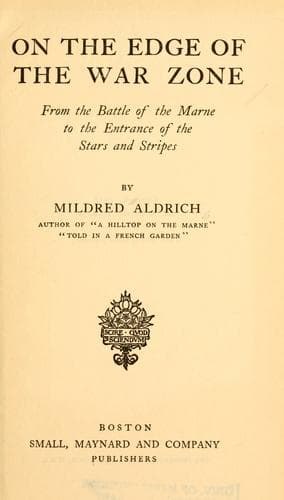
On the Edge of the War Zone: From the Battle of the Marne to the Entrance of the Stars and StripesAldrich, Mildred
History
On the Edge of the War Zone: From the Battle of the Marne to the Entrance of the Stars and Stripes
Aldrich, Mildred
World War, 1914-1918 -- Personal narratives
Verdun itself is only one day's march from Metz. If you study it up on
a map you will learn that, within a circuit of thirty miles, Verdun is
protected by thirty-six redoubts. But what you will not learn is that this
great fortification is not yet connected with its outer redoubts by the
subterranean passages which were a part of the original scheme. It is
that fact which is disturbing. Every engineer in the French army
knows that the citadel at Metz has underground communications with
all its circle of outer ramparts. Probably every German engineer
knows that Verdun's communication passages were never made.
Isn't it strange (when we remember that, even in the days of walled
cities, there were always subterraneans leading out of the fortified
towns beyond the walls--wonderful works of masonry, intact today,
like those of Provins, and even here on this hill) that a nation which
did not want war should have left unfinished the protection of such a
costly fortress?
You probably knew, as usual, before we did, that the battle had
begun. We knew nothing of it here until February 23, three days after
the bombardment began, with the French outer lines nine miles
outside the city, although only twenty-four hours after was the full
force of the German artillery let loose, with fourteen German divisions
waiting to march against the three French divisions holding the
position. Can you wonder we are anxious?
We have been buoyed up for weeks by the hope of an Allied
offensive--and instead came this!
The first day's news was bad, so was that of the 24th. I have never
since the war began felt such a vibrant spirit of anxiety about me. To
add to it, just before midnight on the 24th snow began to fall. In the
morning there was more snow on the ground than I had ever seen in
France. It was a foot deep in front of the house, and on the north
side, where it had drifted, it was twice that depth. This was so unusual
that no one seemed to know what to do. Amélie could not get to me.
No one is furnished with foot-gear to walk in snow, except men who
happen to have high galoshes. I looked out of the window, and saw
Père shovelling away to make a path to the gate, but with an iron
shovel it was a long passage. It was nine o'clock before he got the
gate open, and then Amélie came slipping down. Père was busy all
day keeping that path open, for the snow continued to fall.
This meant that communications were all stopped. Trains ran slowly
on the main lines, but our little road was blocked. It continued to snow
for two days, and for two days we had no news from the outside
world.
On the morning of the 27th one of our old men went to the Demi-
Lune and watched for a military car coming in from Meaux. After
hours of waiting, one finally appeared. He ran into the road and hailed
it, and as the chauffeur put on his brakes, he called:
"Et Verdun?"
"Elle tient," was the reply, and the auto rushed on.
That was all the news we had in those days.
Public-domain text, read in full here on John Shaqi.
Reviews
Reviews
No reviews yet
Be the first to share your thoughts on this work.
Elsewhere in the archive
Join the Discussion
Join the discussion
Sign in to leave a comment or review.
Sign InorCreate an account